Diagnosis
Whipple's disease
A systemic chronic infection caused by the gram-positive bacterium Tropheryma whipplei.
Etiology
Cause [irg]
Unknown host factors + Tropheryma whipplei (non-acid fast, PAS-positive, rod-shaped, and Gram-positive bacillus)
T whipplei is found in patients who are asymptomatic, suggesting that Whipple disease is a manifestation of an abnormal host response
Pathophysiology [irg][srt][qt8]
Most are asymptomatic carriers or develop a limited infection --> develop immunity
Host immunity plays an important role the pathophysiology:
The inflammatory response is muted (impaired type 1 T-cell response)
Clinical manifestation:
Systemic infection: Fever, asthenia, sweats
Gastrointestinal: infiltration of the lamina propria --> disruption of normal villous function --> malabsorption, diarrhea, abdominal pain, weight loss
Joints: synovial infiltration --> arthralgia
Cardiovascular system: infiltration of heart valves --> endocarditis
CNS: dementia, meningoencephalitis, ataxia and clonus
Risk factors [irg][kkn]
Genetic disposition, HLA-B27, HLA DRB1*13, HLA DQB1*06, middle-aged white men (North America and western Europe)
Complications [5eh]
Nutritional deficiencies
Sepsis
Brain damage
Death
Epidemiology
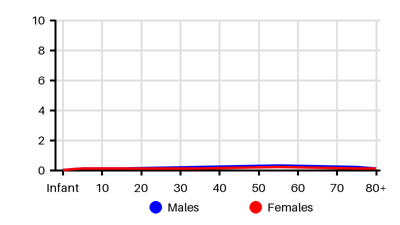
Incidence per 100.000 [irg][srt][5eh]
Symptoms & findings
Symptoms
Anorexia, Arthralgia, Arthritis, Ataxia, Borborygmus, Cachexia, Cheilitis, Chills, Clonus, Confusion, Cough, Decreased consciousness, Dementia, Diarrhea, Diastolic murmur, Dyspnea, Edema, Fatigue, Fever, Gingivitis, Glossitis, Headache, Heart murmur, Hematochezia, Hyperpigmentation, Lymphadenopathy, Myalgia, Myorhythmia, Night blindness, Seizure, Steatorrhea, Supranuclear ophthalmoplegia, Systolic murmur, Trousseau's sign, Weight loss
Clinical findings
Anemia, Chvostek's sign, Decreased Albumin, Elevated CRP, Hypocalcemia, ST elevation
Anamneses
None listed.
Localized findings
Approach
Sample: Fecal, saliva, blood [srt]
Blood culture: very slow growth [srt]
Quantitative PCR
Biopsy of bowels/lymphnode: immunohistochemistry, FISH, electron microscopy
Endoscopy
CT abdomen
MR caput
Treatment
Antiobiotic treatment: IV streptomycin/ceftriaxone/meropenem for 2 weeks and then oral trimethoprim-sulfamethoxazole for 1-2 years [irg][srt][5eh]
Doxycycline + hydroxychloroquine for 12-18 months + lifetime doxycycline
Other therapies: Tetracyclins, beta-lactams, cephalosporins, aminoglycosides, rifamycins, macrolids, phenicols, trimethoprim-sulfamethoxazole, and glycopeptides.
Differential diagnoses
Abdominal angina, Celiac disease, Crohn disease, Encephalitis, Endocarditis, Gastroenteritis, HIV, Hyperthyroidism, Mixed connective tissue disease, Pneumonia, Progressive multifocal leukoencephalitis, Rheumatoid arthritis, Sarcoidosis, Sepsis, Tropical sprue, Tuberculosis, Ulcerative colitis, Uveitis
References
[1] Boumaza A, Ben Azzouz E, Arrindell J, Lepidi H, Mezouar S, Desnues B. Whipple's disease and Tropheryma whipplei infections: from bench to bedside. Lancet Infect Dis. 2022 Oct;22(10):e280-e291.
[2] Dolmans RA, Boel CH, Lacle MM, Kusters JG. Clinical Manifestations, Treatment, and Diagnosis of Tropheryma whipplei Infections. Clin Microbiol Rev. 2017 Apr;30(2):529-555.
[3] Durand DV, Lecomte C, Cathébras P, Rousset H, Godeau P. Whipple disease. Clinical review of 52 cases. The SNFMI Research Group on Whipple Disease. Société Nationale Française de Médecine Interne. Medicine (Baltimore). 1997 May;76(3):170-84.
[4] Stezin A, Pal PK. Treatable Ataxias: How to Find the Needle in the Haystack? J Mov Disord. 2022 Sep;15(3):206-226.
[5] Antunes C, Singhal M. Whipple Disease. Updated 2023 Jul 4: https://www.ncbi.nlm.nih.gov/books/NBK441937/
[6] http://emedicine.medscape.com/article/183350 (2014-01-31); [Medscape]