Diagnosis
Pituitary adenoma
Benign tumor arising from anterior lobe of the pituitary gland:
Macroadenoma: > 1 cm diameter
Microadenoma: < 1 cm diameter
Giant tumor: > 4 cm diameter
Also known as: Pituitary neuroendocrine tumor, Prolactinoma
Etiology
Cause [f9q]
Sporadic clonal expansion of mutated cells of unknown cause (95%)
Specific genes mutations such as MEN, CNC, FIPA (5%)
Pathophysiology [f9q][kog]
Usually benign and asymptomatic (43%)
Symptomatic tumors due to:
Hormone secretion --> Hormonal excess
Hypopituitarism --> Hormonal deficiency
Compression of the surrounding tissue:
Visual impairment
Headache
Types: [yfp][af1]
Prolactinoma (60-70%): amenorrhea, galactorrhea, gynacomastia
ACTH-secreting adenoma/Cushing disease (6%): obesity
Growth hormone secreting adenoma: gigantism and acromegaly
TSHoma: elevated and unsuppressed TSH --> elevated thyroxine --> secondary hyperthyroidism
Gonadotrophinoma: precocious puberty or ovarian hyperstimulation syndrome
Incidentaloma/Non-functioning adenoma (15%): non-secreting pituitary adenoma
Adults: 15–30% of clinically relevant pituitary adenomas and 50–60% of surgical cases
Children: 4–6% of all pediatric pituitary adenomas, 10% of surgical cases
Epidemiology
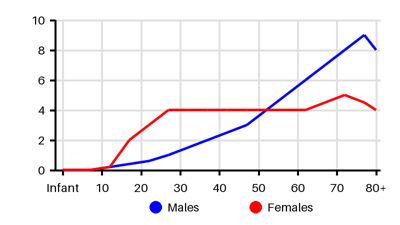
Incidence per 100.000 [tzt][dm5][5mp][f9q][oes][qkh][wot]
Symptoms & findings
Symptoms
Alopecia, Amenorrhea, Arthralgia, Ataxia, Bilateral hemianopsia, Cold intolerance, Decreased libido, Delayed puberty, Failure to thrive, Fasciculations, Fatigue, Galactorrhea, Growth retardation, Headache, Hepatomegaly, Hyperhidrosis, Hyperpigmentation, Hypertension, Hypertrichosis, Impotence, Infertility, Muscle weakness, Paresis, Paresthesia, Polydipsia, Polyuria, Weight loss
Clinical findings
Anemia, Cardiomegaly, Decreased ACTH, Decreased ADH, Decreased FSH, Decreased GH, Decreased LH, Elevated ACTH, Elevated Cortisol, Elevated FSH, Elevated GH, Elevated LH, Elevated T3, Elevated T4, Elevated TSH, Gynecomastia, Hyperglycemia, Hypernatremia, Hyperprolactinemia, Hypoglycemia, Hyponatremia, Macroglossia
Anamneses
None listed.
Localized findings
Approach
Prolactinoma: serum prolactin [yfp]
Cushing disease: plasma ACTH, serum cortisol (midnight), salivary cortisol (late night), 24-h urinary free cortisol, dexamethasone suppression test
Growth hormone adenoma: IGF-1/GH suppressed after an oral glucose load
THSoma: TSH, free T4
Gonadotrophinoma: FSH, LH, β-hCG, testosterone, estrogen, testicular ultrasound
Incidentaloma/Non-functioning adenoma: exclusion of hormones disturbances
CT caput
MRI caput
Treatment
Prolactinoma: [yfp]
Dopamine agonist (Cabergoline) --> reduce serum prolactin and induce tumor shrinkage
Surgery if:
The patient is unable to tolerate or is resistant to high-dose cabergoline
Deteriorating vision on cabergoline
Radiotherapy if surgery is not an option
Consider Temozolomide when resistant to medical, surgical and radiation therapy
Cushing disease:
Surgery: Adenomectomy
Radiotherapy if not amenable to curative surgery
Medical therapy with adrenal steroidogenesis inhibitors (metyrapone or ketoconazole) reduce the cortisol burden while awaiting definitive surgery/radiotherapy
Etomidate IV if severe Cushing disease with severe cortisol excess
Bilateral adrenalectomy if severe refractory Cushing disease or for life-threatening emergencies
GH-secreting adenoma: gigantism and acromegaly
Surgery to reduce GH
Consider preoperative medical therapy with somatostatin analogues and/or GH receptor antagonists
Radiotherapy if uncontrolled tumor growth and incomplete surgical and medical response
TSHoma:
Somatostatin analogue to normalize thyroid function
Definitive surgery: transsphenoidal resection
Radiotherapy if:
Tumor remnant
Resistance to medical therapy
Relapsing TSHomas and re-operation is not an option
Gonadotrophinoma:
Surgical resection
Postoperative remnant or recurrence --> radiotherapy
Incidentaloma/Non-functioning adenoma:
Transsphenoidal surgery if hypopituitarism or visual disturbances
Consider second surgery or radiotherapy
MRI surveillance at 3 and 6 months, and 1, 2, 3 and 5 years after surgery
Differential diagnoses
Acromegaly, Adrenal insufficiency, Astrocytoma, Basilar artery thrombosis, Cerebral venous sinus thrombosis, Craniopharyngioma, Cushings disease, Cushing syndrome, Dermoid Cyst, Diabetes mellitus, Ependymoma, Gigantism, Glioblastoma multiforme, Glioma, Hypopituitarism, Hypothyroidism, Lymphoma, Meningioma, Meningitis, Osteoporosis, Polyneuropathy, Prolactinoma
References
[1] McDowell BD, Wallace RB, Carnahan RM, Chrischilles EA, Lynch CF, Schlechte JA. Demographic differences in incidence for pituitary adenoma. Pituitary. 2011 Mar;14(1):23-30.
[2] Russ S, Anastasopoulou C, Shafiq I. Pituitary Adenoma. [Updated 2023 Mar 27]. In: StatPearls [Internet]. Treasure Island (FL): StatPearls Publishing; 2025 Jan-. Available from: https://www.ncbi.nlm.nih.gov/books/NBK554451/
[3] Korbonits M, Blair JC, Boguslawska A, Ayuk J, Davies JH, Druce MR, Evanson J, Flanagan D, Glynn N, Higham CE, Jacques TS, Sinha S, Simmons I, Thorp N, Swords FM, Storr HL, Spoudeas HA. Consensus guideline for the diagnosis and management of pituitary adenomas in childhood and adolescence: Part 1, general recommendations. Nat Rev Endocrinol. 2024 May;20(5):278-289.
[4] Daly AF, Rixhon M, Adam C, Dempegioti A, Tichomirowa MA, Beckers A. High prevalence of pituitary adenomas: a cross-sectional study in the province of Liege, Belgium. J Clin Endocrinol Metab. 2006 Dec;91(12):4769-75.
[5] Alnasrallah N, Aljenaee K, AlMurshed M, Hajji S. Clinically functioning gonadotropin-secreting pituitary adenoma. Endocrinol Diabetes Metab Case Rep. 2024 Mar 20;2024(1):22-0322.
[6] Graffeo CS, Yagnik KJ, Carlstrom LP, Lakomkin N, Bancos I, Davidge-Pitts C, Erickson D, Choby G, Pollock BE, Chamberlain AM, Van Gompel JJ. Pituitary Adenoma Incidence, Management Trends, and Long-term Outcomes: A 30-Year Population-Based Analysis. Mayo Clin Proc. 2022 Oct;97(10):1861-1871.
[7] Hemminki K, Försti A, Ji J. Incidence and familial risks in pituitary adenoma and associated tumors. Endocr Relat Cancer. 2007 Mar;14(1):103-9.
[8] Mindermann T, Wilson CB. Age-related and gender-related occurrence of pituitary adenomas. Clin Endocrinol (Oxf). 1994 Sep;41(3):359-64.
[9] Gittleman H, Ostrom QT, Farah PD, Ondracek A, Chen Y, Wolinsky Y, Kruchko C, Singer J, Kshettry VR, Laws ER, Sloan AE, Selman WR, Barnholtz-Sloan JS. Descriptive epidemiology of pituitary tumors in the United States, 2004-2009. J Neurosurg. 2014 Sep;121(3):527-35.
[10] Day PF, Loto MG, Glerean M, Picasso MF, Lovazzano S, Giunta DH. Incidence and prevalence of clinically relevant pituitary adenomas: retrospective cohort study in a Health Management Organization in Buenos Aires, Argentina. Arch Endocrinol Metab. 2016 Nov-Dec;60(6):554-561.