Diagnosis
Toxic nodular goiter
Excessive production of thyroid hormones from functionally autonomous thyroid nodule which does not require TSH:
Nodular goiter: ≥ 1 nodule
Multinodular goiter: ≥ 2 nodules
Diffuse goiter: a smooth and uniformly enlarged thyroid gland
Also known as: Plummer Disease, Plummer's disease, Toxic adenoma, Toxic multinodular goitre
Etiology
Cause [cpt]
Prolonged exposure to proliferative stimuli
Iodine deficiency
Elevated TSH
Smoking
Stress
Drugs
Genetic factors (family history)
Pathophysiology [cpt][9kz]
Chronic low-grade stimuli:
Iodine deficiency --> decreased T4 --> compensatory diffuse thyroid hyperplasia
Long-lasting elevated TSH --> diffuse thyroid hyperplasia
Increased risk of mutation in the TSH receptor -> continuously active TSH receptor
Toxic adenoma: autonomous nodule(s) independent of pituitary TSH feedback)
Clinical presentation:
Heat intolerance
Weight loss
Tremors
Palpitations, tachycardia, atrial fibrillation
Increased bowel frequency
Menstrual irregularity
Sweaty palms, excessive sweating
Complications [cpt]
Hyperthyroidism: osteoporosis, bone fractures, tachycardia, arrhythmia, atrial fibrillation, or heart failure
Thyroid cancer
Thyroid storm
Mechanical compression of trachea and esophagus: dyspnea, voice hoarseness, dysphagia, tracheomalacia, asphyxiation
Epidemiology
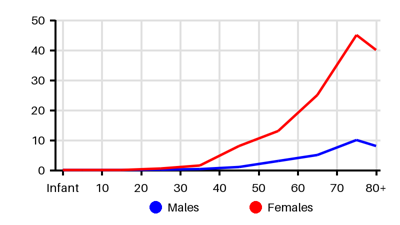
Incidence per 100.000 [cpt][8dw][qgp][1wr][rso][ybe]
Symptoms & findings
Symptoms
Diarrhea, Fatigue, Heat intolerance, Hyperhidrosis, Hyperkinesis, Increased appetite, Irritability, Muscle atrophy, Muscle weakness, Palpitations, Restlessness, Tachycardia, Tremor, Weight loss, Wide pulse pressure
Clinical findings
Atrial fibrillation, Decreased TSH, Elevated T3, Elevated T4, Gynecomastia, Increased iodide uptake
Anamneses
None listed.
Localized findings
Approach
Blood test: TSH, T3, T4, complete blood count, liver function tests, Antithyroid peroxidase (anti-TPO), antithyroglobulin antibodies, Thyroid stimulating immunoglobulin
Thyroid scintigraphy: Radioactive iodide uptake
Ultrasound collum
Fine needle aspiration cytology (FNAC)
CT and MRI
Laryngoscopy
Treatment
Subclinical hyperthyroidism --> monitored without intervention [cpt]
Surgery: lobectomy or total thyroidectomy is the mainstay therapy [ybe]
Complications: damage to the recurrent laryngeal nerves, hypoparathyroidism
Recurrence rate: near zero
Radioactive iodine
Recurrence rate: 15–25%
Antithyroid drugs: if neither surgery or radioactive iodine is possible
Differential diagnoses
Graves disease, Hashimotos thyroiditis, Osteoporosis, Riedels fibrosing thyroiditis, Struma ovarii, Subacute thyroiditis, Thyroid cancer, Toxic thyroid adenoma
References
[1] Khalid N, Can AS. Plummer Disease. Updated 2023 Mar 11: https://www.ncbi.nlm.nih.gov/books/NBK565856/
[2] Knobel M. Etiopathology, clinical features, and treatment of diffuse and multinodular nontoxic goiters. J Endocrinol Invest. 2016 Apr;39(4):357-73. doi: 10.1007/s40618-015-0391-7. Epub 2015 Sep 21.
[3] Censi S, Salmaso L, Ceccato F, Manso J, Fedeli U, Saia M, Mian C. Hyperthyroidism incidence in a large population-based study in northeastern Italy. Endocr Connect. 2023 Nov 14;12(12):e230292.
[4] Baltisberger BL, Minder CE, Bürgi H. Decrease of incidence of toxic nodular goitre in a region of Switzerland after full correction of mild iodine deficiency. Eur J Endocrinol. 1995 May;132(5):546-9.
[5] Abraham-Nordling M, Bystrom K, Torring O, Lantz M, Berg G, Calissendorff J, et al. Incidence of hyperthyroidism in Sweden. European journal of endocrinology / European Federation of Endocrine Societies. 2011;165(6):899–905.
[6] Abraham-Nordling M, Törring O, Lantz M, Hallengren B, Ohrling H, Lundell G, Calissendorff J, Jörneskog G, Wallin G. Incidence of hyperthyroidism in Stockholm, Sweden, 2003-2005. Eur J Endocrinol. 2008 Jun;158(6):823-7.
[7] Sjölin, G., Watt, T., Byström, K. et al. Long term outcome after toxic nodular goitre. Thyroid Res 15, 20 (2022).
[8] http://emedicine.medscape.com/article/120497 (2014-01-02); [Medscape]