Diagnosis
Graves disease
Autoimmune disorder resulting in hyperthyroidism which can cause systemic manifestations that primarily affect heart, skeletal muscle, eyes, skin, bone, and liver.
Also known as: Autoimmune hyperthyroidism, Basedow's disease, Graves-Basedow disease, Toxic diffuse goiter
Etiology
Cause/Pathophysiology [wc1]
Susceptible genes triggered --> autoimmune disorder
Immunoglobulins binding TSH-reseptors
Stimulating excess production of thyroid hormone and thyroid gland growth
Increased metabolic rate:
Tachycardia, systolic hypertension, sweating, heat intolerance, tremors, lid lag, fatigue, weight loss, atrial fibrillation, palpitation, hyper defecation, insomnia, anxiety, nervousness, hyperkinesia, hyperreflexia, dyspnea, muscle weakness, pruritus, polyuria, oligomenorrhea or amenorrhea, loss of libido, palmar erythema and onycholysis, hair loss
Ophthalmopathy is caused by inflammation, cellular proliferation and excess of retro-orbital connective and adipose tissues
Pretibial myxedema
Thyroid acropachy
Risk factors [wc1]
Stress
Smoking
Infection
Iodine excess
Postpartum
Highly active antiretroviral therapy
Complications [wc1]
Thyroid storm (high morbidity and mortality)
Agranulocytosis related to the thionamides
Epidemiology
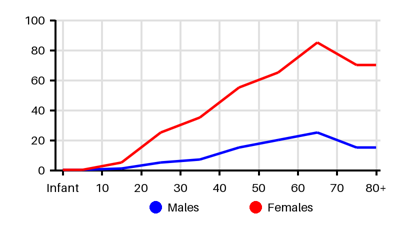
Incidence per 100.000 [gef][ccn][icd][7qp][wc1]
Symptoms & findings
Symptoms
Alopecia, Amenorrhea, Anxiety, Change in bowel habits, Decreased libido, Diaphoresis, Diplopia, Dyspnea, Exophthalmos, Fatigue, Heat intolerance, Impotence, Increased appetite, Infertility, Insomnia, Irritability, Myxedema, Nail clubbing, Night sweats, Oligomenorrhea, Onycholysis, Palpitations, Photophobia, Polydipsia, Polyuria, Restlessness, Tachycardia, Tremor, Vascular murmur, Weakness, Weight loss, Wide pulse pressure
Clinical findings
Anemia, Decreased HDL, Decreased TSH, Elevated ALAT, Elevated ALP, Elevated ASAT, Elevated Bilirubin, Elevated T3, Elevated T4, Gynecomastia, Hypercalcemia, Increased iodide uptake, Thrombocytopenia
Anamneses
None listed.
Localized findings
Approach
Blood test: TSH, free T4, free T3, TSH receptor antibody
Radioactive iodide uptake
Thyroid Ultrasonogram with Doppler: hypervascular
CT or MRI of orbits
Treatment
Treatment goal: rapid symptoms control and reduction of thyroid hormone secretion [wc1]
Tachycardia >90/min: Beta blocker and/or calcium channel blockers
Ophthalmopathy: Correction of thyroid hormone + prednisone/Rituximab
Reduce thyroid hormone synthesis:
Antithyroid drugs which block thyroid hormone synthesis:
Methimazole (nonpregnant patients)
Propylthiouracil (1st trimester)
Radioactive iodine treatment of the thyroid gland
Total or subtotal thyroidectomy
Large goiter
Neck compressive symptoms
Suspicious thyroid cancer
Large thyroid nodules
Cold nodules
Co-existing parathyroid adenoma
High TRAb
Graves orbitopathy
Differential diagnoses
Acute thyroiditis, Anxiety, Cocaine toxicity, Hashimotos thyroiditis, Pheochromocytoma, Pituitary adenoma, Postpartum thyroiditis, Struma ovarii, Subacute thyroiditis, Thyroid cancer, Toxic nodular goiter, Toxic thyroid adenoma, Wolff-Parkinson-White Syndrome
References
[1] Pokhrel B, Bhusal K. Graves Disease. [Updated 2023 Jun 20]: https://www.ncbi.nlm.nih.gov/books/NBK448195/
[2] Andersen SL, Laurberg P. Managing hyperthyroidism in pregnancy: current perspectives. Int J Womens Health. 2016 Sep 19;8:497-504.
[3] Berglund J, Christensen SB, Hallengren B. Total and age-specific incidence of Graves' thyrotoxicosis, toxic nodular goitre and solitary toxic adenoma in Malmö 1970-74. J Intern Med. 1990 Feb;227(2):137-41.
[4] Williamson S, Greene SA. Incidence of thyrotoxicosis in childhood: a national population based study in the UK and Ireland. Clin Endocrinol (Oxf). 2010 Mar;72(3):358-63.
[5] Havgaard Kjær R, Smedegård Andersen M, Hansen D. Increasing Incidence of Juvenile Thyrotoxicosis in Denmark: A Nationwide Study, 1998-2012. Horm Res Paediatr. 2015;84(2):102-7.
[6] http://emedicine.medscape.com/article/120619 (2014-01-02); [Medscape]