Diagnosis
Pyloric stenosis
Abnormal hypertrophy of the pylorus muscles.
Also known as: IHPS, Infantile hypertrophic pyloric stenosis
Etiology
Cause [48x]
Environmental factors
Hereditary factors
Abnormal myenteric plexus innervation
Infantile hypergastrinemia
Exposure to macrolide antibiotics
Deficiency of nitric oxide synthase containing neurons:
Nitric oxide --> inhibitory nonadrenergic, noncholinergic neurotransmitter --> causing relaxation of smooth muscle of the myenteric plexus
Impairment of neuronal nitric oxide synthase (nNOS) synthesis --> infantile hypertrophic pyloric stenosis
Pathophysiology [zcw][fqn]
Pyloric muscle hypertrophy/hyperplasia in pyloric stenosis develops postnatally
This cause narrowing of the pyloric canal --> gastric outlet obstruction
Clinical manifestation:
Postprandial non-bilious "projectile" vomiting starting at 3 to 10 weeks of age
Dehydration and weight loss
Risk factors [fqn]
Bottle feeding
Preterm birth
Cesarean section delivery
First-born
Smoking during pregnancy
Complication [fqn]
Dehydration
Hypovolemic shock
Epidemiology
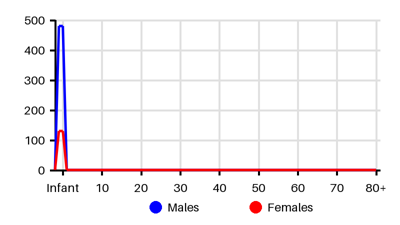
Incidence per 100.000 [ndv][p6g][dc9][irf][sq9][hdp][hp2]
Symptoms & findings
Symptoms
Dehydration, Dry mucous membranes, Flat neck veins, Poor skin turgor, Regurgitation, Vomiting, Weight loss
Clinical findings
Aciduria, Alkalosis, Hypochloremia, Hypokalemia, Metabolic alkalosis
Anamneses
None listed.
Localized findings
Approach
Clinical diagnosis:
Postprandial non-bilious vomiting in infants between 3-10 weeks of age
Palpable pyloric “olive” to the right of the epigastric area
Barium contrast
Blood gas
Ultrasound abdomen
Urine analysis
Treatment
Medical treatment: rehydration and correcting electrolyte imbalances
5% dextrose with 0.25% NaCl
2 meq KCl per 100 mL
Nasogastric tube for decomression
Surgery: Ramstedt pyloromyotomy
The pyloric muscle is divided down to the submucosa
Differential diagnoses
Adrenal crisis, Adrenal insufficiency, Appendicitis, Congenital diaphragmatic hernia, Constipation, Gastroenteritis, Hirschsprung's Disease, Inguinal hernia, Intestinal malrotation, Necrotizing enterocolitis, Pyelonephritis, Renal failure, Sepsis, Testicular torsion, Toxic megacolon, Urinary tract infection
References
[1] http://emedicine.medscape.com/article/803489 (2014-01-02); [Medscape]
[2] Rollins MD, Shields MD, Quinn RJM, Wooldridge MAW. Pyloric stenosis: congenital or acquired? Arch Dis Child 1989;64:138–47.
[3] Garfield K, Sergent SR. Pyloric Stenosis. [Updated 2023 Jan 30]. In: StatPearls [Internet]. Treasure Island (FL): StatPearls Publishing; 2025 Jan-. Available from: https://www.ncbi.nlm.nih.gov/books/NBK555931/
[4] Schechter R, Torfs CP, Bateson TF. The epidemiology of infantile hypertrophic pyloric stenosis. Paediatr Perinat Epidemiol. 1997 Oct;11(4):407-27.
[5] Pedersen RN, Garne E, Loane M, Korsholm L, Husby S; EUROCAT Working Group. Infantile hypertrophic pyloric stenosis: a comparative study of incidence and other epidemiological characteristics in seven European regions. J Matern Fetal Neonatal Med. 2008 Sep;21(9):599-604.
[6] Nielsen JP, Haahr P, Haahr J. Infantile hypertrophic pyloric stenosis. Decreasing incidence. Dan Med Bull. 2000 Jun;47(3):223-5.
[7] Sommerfield T, Chalmers J, Youngson G, Heeley C, Fleming M, Thomson G. The changing epidemiology of infantile hypertrophic pyloric stenosis in Scotland. Arch Dis Child. 2008 Dec;93(12):1007-11.
[8] To T, Wajja A, Wales PW, Langer JC. Population demographic indicators associated with incidence of pyloric stenosis. Arch Pediatr Adolesc Med. 2005 Jun;159(6):520-5.
[9] Rasmussen L, Green A, Hansen LP. The epidemiology of infantile hypertrophic pyloric stenosis in a Danish population, 1950–84. Int J Epidemiol 1989;18:413–7.
[10] Chong AY, Lee HP. Pyloric stenosis in the ethnic groups of Singapore. Singapore Med J. 1976 Sep;17(3):181-3.