Diagnosis
Intracerebral hemorrhage
Hemorrhage in the brain parenchyma or the ventricular system. Intracerebral hemorrhage is the second most common cause of stroke after ischemic stroke.
Also known as: Brain hemorrhage, Cerebral hemorrhage, Hemorrhagic stroke, ICH
Etiology
Cause [rus][kyi]
Traumatic
Spontaneous non-traumatic:
Primary: >85% of hemorrhagic strokes
Hypertension
Cerebral amyloid angiopathy
Secondary:
Atherosclerosis
Aneurysm
AV-malformation
Blood disorders like hemophilia/sickle cell anemia
Liver failure
Brain tumor
Infection
Eclampsia
Drug abuse: cocaine
Cerebral venous sinus thrombosis
Reperfusion injury (hemorrhagic transformation)
Pathophysiology [kyi]
The initial extravasation of blood into the parenchyma
Subsequent bleeding around the clot causing expansion
Swelling or edema around the hematoma
Sudden increase in intracranial pressure
Compression and disruption of the surrounding neuronal tissue
Focal neurological deficit, decreased level of consciousness
May cause herniation --> lower cerebral perfusion pressures --> secondary brain injury
Risk factors [o5w]
Hypertension
Diabetes
Hearth disease
Atrial fibrillation
Smoking
Alcohol
Anticoagulant drugs
Antiplatelet drugs
Dyslipidemia
Pre-TIA
Complications [kyi]
Intraventricular hemorrhage
Obstructive hydrocephalus
Seizures
Deep vein thrombosis
Pulmonary embolism
Epidemiology
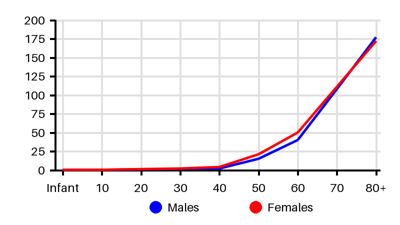
Incidence per 100.000 [ago][dks][w39][o5w][wtk]
Symptoms & findings
Symptoms
Anisocoria, Anorexia, Aphasia, Apraxia, Ataxia, Bilateral hemianopsia, Bradycardia, Cheyne-Stokes respiration, Coma, Confusion, Cushing's triad, Decreased consciousness, Diplopia, Dysphasia, Fever, Headache, Hemiplegia, Hypertension, Irregular respiration, Lethargy, Myalgia, Nausea, Neck stiffness, Paralysis, Paresis, Paresthesia, Retinal hemorrhage, Seizure, Unconsciousness, Vomiting, Wide pulse pressure
Clinical findings
Decreased Blood Urea Nitrogen, Decreased Uric Acid, Elevated Intracranial Pressure, Hyponatremia, Hyposmolality, Papilledema
Anamneses
Localized findings
Approach
Blood test: Platelets, PT-INR, aPTT, infection-tests, electrolytes, osmolarity, toxicology screen (alcohol)
Ophtalmoscopy
CT caput
MR caput
Lumbar puncture
ECG
Biopsy
Treatment
Airway: endotracheal intubation for airway protection if decreased consciousness [rus]
If increased intracranial pressure:
Hyperventilate
Mannitol
Antihypertensive agents to lower blood pressure (mean arterial pressure < 130 mm Hg): Labetalol, Nicardipine, Mannitol, Acetaminophen
Maintain euvolemia
Avoid hyperthermia
Correct coagulopathy: fresh frozen plasma, vitamin K, protamine, platelet transfusions
Anticonvulsant if seizure: phenytoin, levetiracetam
Profylaxis: Antacids, statins
Nonsurgical management:
Minimal neurological deficits
Intracerebral hemorrhage volumes less than 10 mL
Bedrest during the first 24 hours
Surgery:
Indication:
Cerebellar hemorrhage greater than 3 cm
Intracerebral hemorrhage associated with a structural vascular lesion
Young patients with lobar hemorrhage
Approach:
Craniotomy and clot evacuation
Stereotactic aspiration with thrombolytic agents
Endoscopic evacuation
Differential diagnoses
Arteriovenous malformation, Brain tumor, Cerebral aneurysm, Cerebral venous sinus thrombosis, Encephalitis, Endocarditis, Epidural hematoma, Epilepsy, Hydrocephalus, Meningitis, Multiple sclerosis, Stroke, Subarachnoid hemorrhage, Subdural hematoma, Syndrome of inappropriate antidiuretic hormone secretion, Toxoplasmosis
References
[1] https://emedicine.medscape.com/article/1163977
[2] Rajashekar D, Liang JW. Intracerebral Hemorrhage. [Updated 2023 Feb 6]. In: StatPearls [Internet]. Treasure Island (FL): StatPearls Publishing; 2025 Jan-. Available from: https://www.ncbi.nlm.nih.gov/books/NBK553103/
[3] Wang S, Zou XL, Wu LX, Zhou HF, Xiao L, Yao T, Zhang Y, Ma J, Zeng Y, Zhang L. Epidemiology of intracerebral hemorrhage: A systematic review and meta-analysis. Front Neurol. 2022 Sep 16;13:915813.
[4] Sacco S, Marini C, Toni D, Olivieri L, Carolei A. Incidence and 10-year survival of intracerebral hemorrhage in a population-based registry. Stroke. 2009 Feb;40(2):394-9.
[5] Krishnamurthi RV, Moran AE, Forouzanfar MH, Bennett DA, Mensah GA, Lawes CM, Barker-Collo S, Connor M, Roth GA, Sacco R, Ezzati M, Naghavi M, Murray CJ, Feigin VL; Global Burden of Diseases, Injuries, and Risk Factors 2010 Study Stroke Expert Group. The global burden of hemorrhagic stroke: a summary of findings from the GBD 2010 study. Glob Heart. 2014 Mar;9(1):101-6.
[6] Li X, Zhang L, Wolfe CDA, Wang Y. Incidence and Long-Term Survival of Spontaneous Intracerebral Hemorrhage Over Time: A Systematic Review and Meta-Analysis. Front Neurol. 2022 Mar 10;13:819737.
[7] Palm F, Henschke N, Wolf J, Zimmer K, Safer A, Schröder RJ, Inselmann G, Brenke C, Becher H, Grau AJ. Intracerebral haemorrhage in a population-based stroke registry (LuSSt): incidence, aetiology, functional outcome and mortality. J Neurol. 2013 Oct;260(10):2541-50.