Diagnosis
Subdural hematoma
Collection of blood between the dura and arachnoid mater:
Acute (< 24 hours)
Subacute (24 hours-2 weeks)
Chronic (> 2 weeks old)
Also known as: SDH, Subdural hemorrhage
Etiology
Cause [svd][psb][idp]
Traumatic:
Cranium extraction device (newborns)
Shaken baby syndrome
Spontaneous non-traumatic:
Anticoagulant or antiplatelet
Tumor
Ruptured aneurysm
Ischemia
Subdural hygroma
Brain atrophy
Pathophysiology [sno]
Dura mater - a protective layer around the brain tissue
Arachnoid mater is under the dura mater with many bridging veins between the layers
Acceleration-deceleration force --> bridging veins may rupture --> subdural hematoma
Larger space between the layers --> stretches bridging veins --> prone to rupture:
Young, growing brain
Aging brain (because of contraction)
A minor subdural bleeding may increase the distance and trigger new bleeding foci
Acute --> subacute --> chronic (development of encapsulating membrane)
Risk factors [idp]
Chronic alcoholism
Epilepsy
Coagulopathy/anticoagulant therapy
Arachnoid cysts
Cardiovascular disease (hypertension, arteriosclerosis)
Thrombocytopenia
Diabetes mellitus
Epidemiology
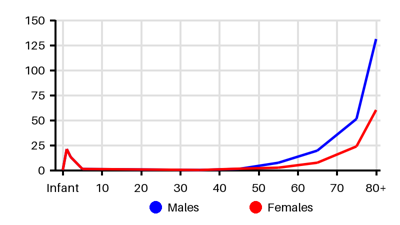
Incidence per 100.000 [sno][v5d][mwu][wbr]
Symptoms & findings
Symptoms
Amnesia, Anisocoria, Anopsia, Anorexia, Apathy, Aphasia, Ataxia, Bradycardia, Cheyne-Stokes respiration, Coma, Confusion, Cushing's triad, Decreased consciousness, Deviated gaze, Diplopia, Dizziness, Drowsiness, Dysarthria, Headache, Irregular respiration, Lethargy, Myalgia, Nausea, Paresis, Paresthesia, Seizure, Unconsciousness, Vomiting, Weakness, Wide pulse pressure
Clinical findings
Decreased Blood Urea Nitrogen, Decreased Uric Acid, Elevated Intracranial Pressure, Hyponatremia, Hyposmolality
Anamneses
Localized findings
Approach
Blood test: complete blood count, prothrombin and activated prothrombin time, metabolic panel
Ophtalmoscopy
CT caput
MR caput
Lumbar puncture
Treatment
Initial treatment: [sno]
Airway
Breathing
Circulation
Conservative non-surgical management: [sno]
The hematoma does not cause impingement on the brain or the brain stem
If increasing hematoma or signs of increased intracranial pressure: [sno][wbr]
Sedation
Neuromuscular blockade when appropriate
Moderate hyperventilation to a Pc02 (32 to 36)
Adequate oxygenation to maintain Sp02 greater than 95%
Head elevation
Avoidance of hyperthermia
Hypertonic saline or mannitol --> decrease the intracranial pressure
Surgery:
Burr hole craniostomy + subdural drain
Craniotomy
Differential diagnoses
Arteriovenous malformation, Brain abscess, Brain tumor, Cerebral aneurysm, Dementia, Encephalitis, Epidural hematoma, Hydrocephalus, Intracerebral hemorrhage, Meningitis, Multiple sclerosis, Stroke, Subarachnoid hemorrhage, Syndrome of inappropriate antidiuretic hormone secretion, Toxoplasmosis, Transient ischemic attack
References
[1] Mehta V, Harward SC, Sankey EW, Nayar G, Codd PJ. Evidence based diagnosis and management of chronic subdural hematoma: A review of the literature. J Clin Neurosci. 2018 Apr;50:7-15.
[2] Fomchenko EI, Gilmore EJ, Matouk CC, Gerrard JL, Sheth KN. Management of Subdural Hematomas: Part I. Medical Management of Subdural Hematomas. Curr Treat Options Neurol. 2018 Jun 23;20(8):28.
[3] https://emedicine.medscape.com/article/1137207
[4] Pierre L, Kondamudi NP. Subdural Hematoma. [Updated 2023 Aug 12]. In: StatPearls [Internet]. Treasure Island (FL): StatPearls Publishing; 2025 Jan-. Available from: https://www.ncbi.nlm.nih.gov/books/NBK532970/
[5] Rauhala M, Luoto TM, Huhtala H, Iverson GL, Niskakangas T, Öhman J, Helén P. The incidence of chronic subdural hematomas from 1990 to 2015 in a defined Finnish population. J Neurosurg. 2019 Mar 22;132(4):1147-1157.
[6] Bartek J Jr, Sjåvik K, Ståhl F, Kristiansson H, Solheim O, Gulati S, Sagberg LM, Förander P, Jakola AS. Surgery for chronic subdural hematoma in nonagenarians: A Scandinavian population-based multicenter study. Acta Neurol Scand. 2017 Nov;136(5):516-520.
[7] El Rahal A, Beck J, Ahlborn P, Bernasconi C, Marbacher S, Wanderer S, Burkhardt JK, Daniel RT, Ferrari A, Hausmann O, Kamenova M, Kothbauer K, Lutz K, Mariani L, Alfieri A, Schöni D, Schucht P, Raabe A, Regli L, Kuhlen D, Seule M, Soleman J, Starnoni D, Zaldivar J, Zweifel C, Schaller K, Fung C. Incidence, therapy, and outcome in the management of chronic subdural hematoma in Switzerland: a population-based multicenter cohort study. Front Neurol. 2023 Sep 14;14:1206996.
[8] Stubbs DJ, Vivian ME, Davies BM, Ercole A, Burnstein R, Joannides AJ. Incidence of chronic subdural haematoma: a single-centre exploration of the effects of an ageing population with a review of the literature. Acta Neurochir (Wien). 2021 Sep;163(9):2629-2637.