Diagnosis
Gastrointestinal hemorrhage
Hemorrhage in the gastrointestinal tract. Usually divided in upper GI bleeding (from the pharynx to the ligament of Treitz) and lower GI bleeding.
Also known as: Gastrointestinal bleeding, GI bleeding, GI hemorrhage
Etiology
Cause of Upper GI --> Usually presents either as hematemesis or melena [q6d]
Ulcer disease (gastrinoma, H. pylori infection, NSAIDs, or stress)
Esophagitis
Esophageal varices
Portal hypertensive gastropathy
Gastritis and Duodenitis
Mallory-Weiss tear
Dieulafoy lesion
Angiodysplasia/arteriovenous malformation
Upper GI tumors/cancer (esophagus/gastric)
Gastric antral valvular ectasia (watermelon stomach)
Cameron lesions (bleeding ulcers occurring at the site of a hiatal hernia)
Aortoenteric fistulas
Foreign body ingestion
Post-surgical bleeds (anastomosis, polypectomy, sphincterotomy)
Hemobilia
Hemosuccus pancreaticus (bleeding from the pancreatic duct)
Drug side effects (NSAIDs, SSRIs, corticosteroids, and anticoagulants)
Cause of Lower GI --> Most commonly presents as hematochezia [q6d]
Diverticulosis/Diverticulitis
Angiodysplasia/arteriovenous malformation
Infectious colitis
Acute mesenteric ischemia
Ischemic colitis
Aortoenteric fistula
Ulcerative colitis
Crohns disease
Colon cancer/polyps
Hemorrhoids
Anal fissures
Rectal varices
Dieulafoy lesion
Radiation
Post-surgical (polypectomy, biopsy, anastomosis)
Risk factors [5pz]
Older age
Male
Smoking
Alcohol
Medications
Complications [q6d]
Respiratory Distress
Myocardial Infarction
Infection
Shock
Death
Epidemiology
Incidence per 100.000 [q6d][tur][5pz][89h][sir][ppz]
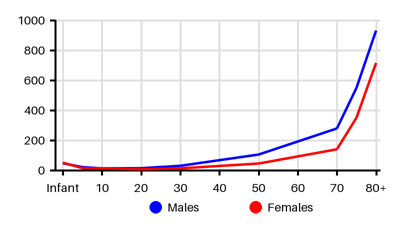
Symptoms & findings
Symptoms
Confusion, Dyspnea, Fatigue, Heartburn, Hematemesis, Hematochezia, Hypotension, Icterus, Melena, Nausea, Syncope, Tachycardia, Tachypnea, Vomiting, Weakness, Weight loss
Clinical findings
Anemia, Decreased hematocrit, Elevated BUN/creatinine ratio, Elevated PT-INR, Jaundice
Anamneses
None listed.
Localized findings
Approach
Blood test: Hemoglobin, hematocrit, PT-INR, prothrombin time, APTT, Lactate, Liver function tests
Blood gas
Gastric lavage
Rectal exam
Hemofec
Gastroscopy: Push enteroscopy
Colonoscopy
Nuclear scintigraphy: Tagged RBC scan
CT angiography
Treatment
Resuscitation [q6d]
Nothing by mouth
Oxygen or intubation
IV fluid resuscitation
Blood grouping and cross match
Transfusions
RBC transfusion if hemoglobin < 7 g/dL
Platelet transfusion if the platelet count < 50,000/uL
Prothrombin complex concentrate if INR > 2
Investigating the underlying cause
Medications [q6d]
PPIs
Prokinetic agents
Vasoactive medications: Somatostatin or octreotide to treat variceal bleeding by inhibiting vasodilatory hormone release
Antibiotics: prophylaxis in patients with cirrhosis to prevent translocation
Anticoagulant/antiplatelet agents: Should be stopped if possible
Consider the reversal of agents on a case-by-case basis dependent on the severity of bleeding and risks of reversal
NGT lavage to remove fresh blood --> facilitate endoscopy
Blakemore or Minnesota tube if patients with hemodynamic instability/massive GI bleeds in the setting of known varices, which should be done only once the airway is secured. This procedure carries a significant complication risk (including arrhythmias, gastric or esophageal perforation).
Surgery in patients with massive bleeding or hemodynamic instability who have bleeding that is not amenable to any other treatment.
Diverticular bleeding --> colonoscopy with bipolar probe coagulation, epinephrine injection, or metallic clips
Angiodysplasia --> thermal therapy (electrocoagulation, argon plasma coagulation)
Differential diagnoses
Acute pancreatitis, Anal fissure, Aortic dissection, Aortoenteric fistula, Arteriovenous malformation, Cholecystitis, Colorectal cancer, Crohn disease, Dengue fever, Dieulafoys lesion, Diverticulitis, Drug side effects, Esophageal varices, Esophagitis, Gastritis, Hemobilia, Hemorrhoids, Infectious colitis, Ischemic colitis, Mallory-Weiss tear, Meckels diverticulum, Myocardial infarction, Proctitis, Radiation colitis, Radiation telangiectasia, Ruptured aortic aneurysm, Stroke, Ulcerative colitis, Ulcer disease, von Willebrand disease, Zollinger-Ellison syndrome
References
[1] DiGregorio AM, Alvey H. Gastrointestinal Bleeding. [Updated 2023 Jun 5]: https://www.ncbi.nlm.nih.gov/books/NBK537291/
[2] Saydam ŞS, Molnar M, Vora P. The global epidemiology of upper and lower gastrointestinal bleeding in general population: A systematic review. World J Gastrointest Surg. 2023 Apr 27;15(4):723-739.
[3] Scherdin Y, Halldestam I, Redeen S. Incidence and Mortality Related to Gastrointestinal Bleeding, and the Effect of Tranexamic Acid on Gastrointestinal Bleeding. Gastroenterology Res. 2021 Jun;14(3):165-172.
[4] Cavallaro LG, Monica F, Germanà B, Marin R, Sturniolo GC, Saia M. Time trends and outcome of gastrointestinal bleeding in the Veneto region: a retrospective population based study from 2001 to 2010. Dig Liver Dis. 2014 Apr;46(4):313-7.
[5] Hreinsson JP, Kalaitzakis E, Gudmundsson S, Björnsson ES. Upper gastrointestinal bleeding: incidence, etiology and outcomes in a population-based setting. Scand J Gastroenterol. 2013 Apr;48(4):439-47.
[6] Laine L, Yang H, Chang SC, Datto C. Trends for incidence of hospitalization and death due to GI complications in the United States from 2001 to 2009. Am J Gastroenterol. 2012 Aug;107(8):1190-5; quiz 1196.
[7] http://emedicine.medscape.com/article/188478 (2014-01-02); [Medscape]
[8] http://emedicine.medscape.com/article/187857 (2014-01-02); [Medscape]
[9] [uptodate.com]
[10] Kocic M, Rasic P, Marusic V, Prokic D, Savic D, Milickovic M, Kitic I, Mijovic T, Sarajlija A. Age-specific causes of upper gastrointestinal bleeding in children. World J Gastroenterol. 2023 Dec 21;29(47):6095-6110.
[11] Menichelli D, Gazzaniga G, Del Sole F, Pani A, Pignatelli P, Pastori D. Acute upper and lower gastrointestinal bleeding management in older people taking or not taking anticoagulants: a literature review. Front Med (Lausanne). 2024 May 3;11:1399429.