Diagnosis
Hepatic encephalopathy
Altered mental status due to accumulation of neurotoxic substances (ammonia, GABA) in the bloodstream.
Also known as: Portal systemic encephalopathy
Etiology
Cause (World Health Congress of Gastroenterology Criteria) [ura]
Type A: Acute liver failure
Type B: Portosystemic shunt allowing blood to bypass the liver (without liver failure)
Type C: Cirrhosis of the liver
Precipitating factors [ura]
Infection
Dehydration (diuretics, diarrhea, vomiting, or excessive paracentesis)
Electrolyte depletion (hyponatremia, hypokalemia, Mg)
Drugs (benzodiazepine, opioid, antidepressant, antipsychotic, salicylate, NSAIDs)
Alcohol
GI bleed
Constipation
Excess dietary protein
Kidney dysfunction and azotemia
TIPS
Pathophysiology [ura]
Colonic bacteria and mucosal enzymes break down dietary proteins --> releasing ammonia in the GI tract
Ammonia is absorbed into the portal circulation --> converted into urea in the liver.
Liver failure or systemic shunting --> ammonia accumulate in the systemic circulation
Hyperammonemia --> astrocyte swelling/dysfunction
Astrocytes maintain electrolyte homeostasis, provide nutrients and neurotransmitter precursors to neurons
Hyperammonemia --> impair neurotransmission --> hepatic encephalopathy:
Early phase: disrupted sleep-wake pattern (sleep during daytime, awake at night)
Intermediate stage: confusion, lethargy, and personality changes
Advanced stage: coma
Complications [ura]
Agitation
Seizure
Residual cognitive impairment
Cerebral edema and brain herniation
Mortality
Epidemiology
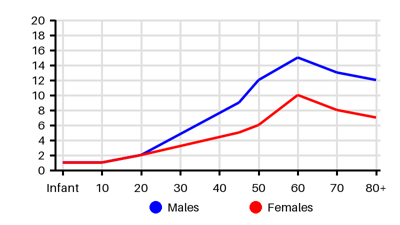
Incidence per 100.000 [mc4][rtu][utr][mzf][gee][w32]
Symptoms & findings
Symptoms
Asterixis, Coma, Decreased consciousness, Edema, Hematochezia, Lethargy, Pruritus, Spider nevus
Clinical findings
Ascites, Decreased Albumin, Elevated Ammonia, Elevated Bilirubin, Elevated Estrogen, Elevated PT-INR, Jaundice, Palmar erythema
Anamneses
None listed.
Localized findings
Approach
Blood test: ammonia, liver function tests, electrolyte levels, complete blood count, kidney function tests, thyroid-stimulating hormone, procalcitonin, CRP
Arterial blood gas
Blood culture
EEG
CT caput
CT abdomen
Ultrasound abdomen
West Haven Criteria [ura]
Grade 1
Trivial lack of awareness
Euphoria or anxiety
Shortened attention span and impaired ability to perform simple calculations (addition or subtraction)
Grade 2
Lethargy or apathy
Minimal disorientation to time or place
Subtle personality changes
Inappropriate behavior
Grade 3
Somnolence to semi-stupor, but responsive to verbal stimuli
Confusion
Gross disorientation
Grade 4
Coma
Treatment
The goals of treatment: [n7s]
Treating the precipitating factor(s)
Improving mental status
The treatment and management of HE depend on its severity and acuity: [ksd]
Acute episode:
Lactulose (non-absorbable disaccharide) is first-line therapy (self-titrate to achieve 2 to 4 soft bowel movements daily)
Rifaximin (non-absorbable oral antibiotic)
L-ornithine L-aspartate i.v. (oral branched-chain amino acids)
Ornithine Phenylacetate
Glycerol Phenylbutyrate
Correct zinc deficiency (low levels of zinc lead to impairment of urea cycle enzymes and glutamine synthetase, thus leading to increased ammonia levels)
Albumin Dialysis
Alternative treatment: neomycin, metronidazole (ototoxicity, nephrotoxicity, and antibiotic resistance)
Prophylaxis: [ura]
Lactulose
Rifaximin
Probiotics
Nutrition: many small meals to prevent fasting (may increase ammonia)
Energy: 35 to 40 kcal/kg/d
Protein: 1.2 to 1.5 g/kg/d
Liver transplantation is the definitive surgery
Differential diagnoses
Alcohol intoxication, Brain abscess, Brain tumor, Drug side effects, Encephalitis, Hypercalcemia, Hypercarbia, Hyperkalemia, Hypernatremia, Hypocalcemia, Hypoglycemia, Hypokalemia, Hyponatremia, Hypoxemia, Inherited urea cycle disorder, Intracerebral hemorrhage, Meningitis, Postseizure encephalopathy, Renal failure, Stroke, Subdural hematoma, Ureterosigmoidostomy, Wernicke encephalopathy
References
[1] Mandiga P, Kommu S, Bollu PC. Hepatic Encephalopathy. [Updated 2025 Jan 20]. In: StatPearls [Internet]. Treasure Island (FL): StatPearls Publishing; 2025 Jan-. Available from: https://www.ncbi.nlm.nih.gov/books/NBK430869/
[2] Maldonado-Garza HJ, Vázquez-Elizondo G, Gaytán-Torres JO, Flores-Rendón AR, Cárdenas-Sandoval MG, Bosques-Padilla FJ. Prevalence of minimal hepatic encephalopathy in cirrhotic patients. Ann Hepatol. 2011 Jun;10 Suppl 2:S40-4.
[3] Liu YB, Chen MK. Epidemiology of liver cirrhosis and associated complications: Current knowledge and future directions. World J Gastroenterol. 2022 Nov 7;28(41):5910-5930.
[4] Louissaint J, Deutsch-Link S, Tapper EB. Changing Epidemiology of Cirrhosis and Hepatic Encephalopathy. Clin Gastroenterol Hepatol. 2022 Aug;20(8S):S1-S8.
[5] Stepanova M, Mishra A, Venkatesan C, Younossi ZM. In-hospital mortality and economic burden associated with hepatic encephalopathy in the United States from 2005 to 2009. Clin Gastroenterol Hepatol. 2012 Sep;10(9):1034-41.e1.
[6] Cordoba J, Ventura-Cots M, Simón-Talero M, Amorós À, Pavesi M, Vilstrup H, Angeli P, Domenicali M, Ginés P, Bernardi M, Arroyo V; CANONIC Study Investigators of EASL-CLIF Consortium. Characteristics, risk factors, and mortality of cirrhotic patients hospitalized for hepatic encephalopathy with and without acute-on-chronic liver failure (ACLF). J Hepatol. 2014 Feb;60(2):275-81.
[7] Vaz J, Eriksson B, Strömberg U, Buchebner D, Midlöv P. Incidence, aetiology and related comorbidities of cirrhosis: a Swedish population-based cohort study. BMC Gastroenterol. 2020 Apr 3;20(1):84.
[8] Flamm SL. Complications of Cirrhosis in Primary Care: Recognition and Management of Hepatic Encephalopathy. Am J Med Sci. 2018 Sep;356(3):296-303.
[9] Patidar KR, Bajaj JS. Covert and Overt Hepatic Encephalopathy: Diagnosis and Management. Clin Gastroenterol Hepatol. 2015 Nov;13(12):2048-61.
[10] http://emedicine.medscape.com/article/186101 (2014-01-02); [Medscape]