Diagnosis
Hypercalcemia
Total calcium >2.6 mmol/L (>10.5 mg/dL).
Ionized calcium >1.30 mmol/L.
Corrected calcium: [3rt]
0.8 (Normal Albumin - Observed Albumin) + Observed Calcium
Corrected calcium (mmol/L) = measured calcium + ([40 - albumin (g/L)] × 0.02)
Measured calcium + 0.8 x (4.0 - albumin)
Etiology
Cause
Primary hyperparathyroidism (adenoma) is the most common cause (87%) [asw][qsc]
Tertiary hyperparathyroidism: Renal failure --> chronic overstimulation --> parathyroid hyperplasia [cdh]
Drugs: Thiazid diuretics, Lithium, Vitamin D, Calcium supplements, Theophylline, Tamoxifen [pgn]
Cancer:
Excessive production of parathyroid hormone–related protein by tumors [cdh]
Osteolytic bone metastasis (breast, multiple myeloma, MEN): 0.5-3% of all malignancies [bpg][nbi]
Immobilization: Imbalance of increased osteoclast activity and decreased osteoblast activity --> bone resorption and hypercalcemia
Less common causes: Sarcoidosis, renal failure, hyperthyroidism (rapid bone turnover), adrenal insufficiency, pheochromocytoma, acromegaly, milk-alkali syndrome, vitamin A derivates (acne-treatment), vitamin D toxicity, immobilisation, Paget disease, familial hypocalciuric hypercalcemia, Williams syndrome, parenteral nutrition, cardiac event, pre-eclampsia, rhabdomyolysis, pheochromocytoma, congenital lactase deficiency [nbi]
Pathophysiology [cdh]
Calcium plays an integral role in neural transmission, enzyme activity, myocardial function, coagulation, intracellular signaling, and hormonal secretion.
Most of the calcium is found in the bones as calcium phosphate, whereas a small percentage is found in cells and extracellular fluids.
Approximately 50% of total calcium is protein bound, and the total calcium level will vary with protein-binding capacity (albumin).
Acidosis (increased hydrogen ions) occupy binding sites on albumin, leading to increased free calcium levels. Thus, calcium levels should be adjusted for serum pH.
The main regulators of calcium homeostasis: [cdh]
Parathyroid hormone: Binding to osteoclasts --> increases bone resorption --> increase serum calcium
Vitamin D: Increases intestinal absorption of calcium
Calcitonin: Increasing calcium deposition in bones + inhibiting renal and intestinal absorption of calcium + increasing urinary calcium excretion --> lowers serum calcium levels
Complications [cdh]
Severe hypercalcemia
Osteoporosis/bone fractures
Nephrolithiasis
Renal failure
Pancreatitis
Gastric ulcer
Paresthesias
Syncope and arrhythmias
Altered mental status
Epidemiology
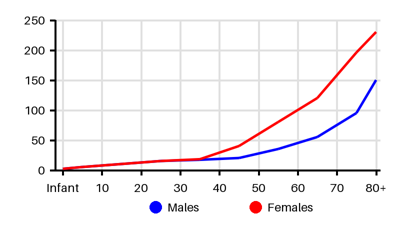
Incidence per 100.000 [asw][qsc][3rt][ug6][bpg]
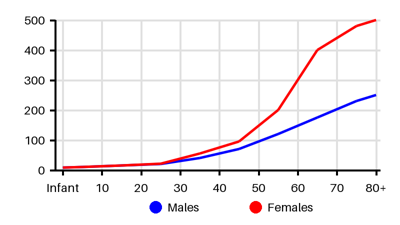
Prevalence per 100.000 [asw][qsc][3rt][ug6][bpg]
Symptoms & findings
Symptoms
Anorexia, Anxiety, Arrhythmia, Arthralgia, Coma, Confusion, Constipation, Depression, Fatigue, Headache, Hematuria, Hypertension, Hyporeflexia, Muscle weakness, Nausea, Nocturia, Polydipsia, Polyuria, Stupor, Tachycardia, Thirst, Vomiting, Weakness, Weight loss
Clinical findings
Elevated PTH, Lytic bone lesion, Osteoporosis, Pathologic fracture, Shortened QT interval, U wave
Anamneses
Localized findings
Approach
Blood test: Ca, Mg, PTH, albumin, vitamin D
Urine: 24 hour urinary calcium
Xray: bone density, pathologic fractures, bony metastases
UL or CT: renal stones, parathyroid adenoma
Treatment
Goal of treatment: [cdh]
Increased elimination from the extracellular fluid
Reduced gastrointestinal absorption
Decreased bone resorption
Treat the underlying cause:
Parathyroidectomy: if primary hyperparathyroidism
Discontinue thiazide
Inhibit osteoclasts
Adequate hydration with increased urinary excretion of calcium [nbi]:
Hydration: Isotonic NaCl (0.9% saline until adequate urine output)
Loop diuretics
Electrolyte replacement: [cdh]
Hypokalemia
Hypomagnesemia
Hypophosphatemia
Calcitonin 4 units/kg every 12 hours to acutely lower calcium levels
Biophosphonates: treating hypercalcemia of malignancy, takes 3 days to lower calcium
Denosumab: treating hypercalcemia of malignancy, antibody inhibits osteoclasts
Corticoids: if lymphoma or granulomatous disease, Prednisone 20-40 mg daily
Mithramycin: inhibits osteoclast RNA synthesis
Cinacalcet (suppression of PTH): treating secondary hyperparathyroidism due to renal failure
Peritoneal dialysis or hemodialysis is rarely needed
Differential diagnoses
Brain tumor, Breast cancer, Cervical cancer, Drug side effects, Hyperparathyroidism, Hypovolemia, Leukemia, Lung cancer, Lymphoma, Multiple myeloma, Ovarian cancer, Renal cancer, Sarcoidosis, Urolithiasis
References
[1] Dent DM, Miller JL, Klaff L, Barron J. The incidence and causes of hypercalcaemia. Postgrad Med J. 1987 Sep;63(743):745-50.
[2] Yeh MW, Ituarte PH, Zhou HC, Nishimoto S, Liu IL, Harari A, Haigh PI, Adams AL. Incidence and prevalence of primary hyperparathyroidism in a racially mixed population. J Clin Endocrinol Metab. 2013 Mar;98(3):1122-9.
[3] Rizk Y, Saad N, Arnaout W, Chalah MA, Farah S. Primary Hyperparathyroidism in Older Adults: A Narrative Review of the Most Recent Literature on Epidemiology, Diagnosis and Management. J Clin Med. 2023 Sep 30;12(19):6321.
[4] Sadiq NM, Anastasopoulou C, Patel G, et al. Hypercalcemia. [Updated 2024 May 7]. In: StatPearls [Internet]. Treasure Island (FL): StatPearls Publishing; 2025 Jan-. Available from: https://www.ncbi.nlm.nih.gov/books/NBK430714/
[5] Lecoq AL, Livrozet M, Blanchard A, Kamenický P. Drug-Related Hypercalcemia. Endocrinol Metab Clin North Am. 2021 Dec;50(4):743-752.
[6] Jick S, Li L, Gastanaga VM, Liede A. Prevalence of hypercalcemia of malignancy among cancer patients in the UK: analysis of the Clinical Practice Research Datalink database. Cancer Epidemiol. 2015 Dec;39(6):901-7.
[7] Smaranda Diaconescu, Nicoleta Gimiga, Claudia Olaru, Marin Burlea. Hypercalcemia in Children. Romanian Journal of Oral Rehabilitation Vol. 6, No. 3, July September 2014.
[8] Wermers RA, Kearns AE, Jenkins GD, Melton LJ 3rd. Incidence and clinical spectrum of thiazide-associated hypercalcemia. Am J Med. 2007 Oct;120(10):911.e9-15.
[9] Griebeler ML, Kearns AE, Ryu E, Hathcock MA, Melton LJ 3rd, Wermers RA. Secular trends in the incidence of primary hyperparathyroidism over five decades (1965-2010). Bone. 2015 Apr;73:1-7.