Diagnosis
Lead toxicity
A toxic condition produced by ingestion, inhalation, or skin absorption of lead, resulting in various dose-related symptoms.
Acute lead exposure: measured in micrograms per deciliter of blood (µg/dL) [iau]
Toxicity in children: < 10 µg/dL
Toxicity in adult: < 25 µg/dL
Chronic lead exposure: measured in micrograms of lead per gram of bone (µg/g) [iau]
Etiology
Cause [4kt]
Inhalation: paint, gasoline, cutting, mining, welding, battery/glass manufacture
Ingestion: tap water due to atmosphere contamination, food
Pathophysiology [4kt]
Lead is not biodegradable and show remarkable environmental persistence [4kt]
Lead has no physiologic role in biological systems and disturbs multiple enzyme systems by mimicking calcium and zinc [aej]
Human organs and tissues have no effective mechanism to excrete lead, thus its concentration inside the body accumulates and increases with age [dpi]
Lead has a half-life of approximately 30 days in the blood, from where it diffuses into the soft tissues, including the kidneys, brain, liver, heart and bone marrow.
Half-life in bone is several decades and lead is primarily excreted in urine and bile
Children inhale more air relative to their body size and absorb 40-50% of the lead they ingest (adults 10-15%) [4kt]
Acute lead toxicity:
Nephropathy: proximal tubule dysfunction --> Fanconi-like syndrome
Abdominal pain
Neuropathy: lead undermine the normal synaptic pruning process
Encephalopathy
Anemia
Chronic lead toxicity: Accumulation in the intestines, lungs, liver, spleen, kidneys, central nervous system and bones and a possible contributing cause of the downfall of the Roman Empire: [dpi][at3]
Neurological Toxicity: irritability, lower IQ, ADHD-symptoms, delirium, convulsions, encephalopathy, headache, ataxia, somnolence, hallucinations
Lethargy, seizures, stupor, coma
Hematological Toxicity: interfering with enzymes in heme synthesis --> Anemia
Gastrointestinal Toxicity: colic, nausea, vomiting and anorexia
Renal Toxicity/hypertension/gout: nephropathy, phosphaturia, glucosuria and proteinuria
Cardiovascular Toxicity: stroke, rheumatic/valvular/ischemic/hypertensive heart disease, cardiomyopathy, myocarditis, endocarditis, atrial fibrillation/flutter, aortic aneurysm, peripheral artery disease, chronic kidney disease, diabetes mellitus types 1/2 [iau]
Reproductive Effects: reduction in libido, abnormal spermatogenesis, chromosomal damage, infertility, stillbirth, miscarriage
Complications [4kt]
Encephalopathy
Hypertension
Cardiovascular morbidity
Chronic or recurrent abdominal pain
Epidemiology
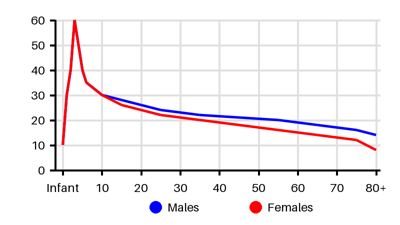
Prevalence per 100.000 [e7i][6qz][iau]
Symptoms & findings
Symptoms
Anorexia, Areflexia, Ataxia, Blindness, Coma, Confusion, Constipation, Dehydration, Delirium, Depression, Developmental delay, Fatigue, Foot drop, Hallucinations, Hand drop, Headache, Hearing loss, Hypertension, Hyporeflexia, Impotence, Insomnia, Irritability, Lethargy, Muscle atrophy, Muscle weakness, Nausea, Paralysis, Paresis, Paresthesia, Polydipsia, Polyuria, Seizure, Somnolence, Stupor, Tremor, Vertigo, Vomiting
Clinical findings
Anemia, Dense metaphyseal lines, Hypokalemia, Hypophosphatemia, Iron deficiency, Metabolic acidosis, Optic neuritis, Periodontitis, Proteinuria
Anamneses
None listed.
Localized findings
Approach
Blood test: blood lead level when acute poisoning
Blood smear
Abdominal x-ray
Long bones x-ray
Ophtalmoscopy
CT caput
MR caput
EEG
Lumbar punture
Free erythrocyte protoporphyrin level
Provocative chelation test (CaNa2 EDTA)
Treatment
Chelators remove lead from blood and tissue (including the brain). Chelation therapy is recommended with a venous BLL ≥45 μg/dL, but should be used with caution. Intravenously administered chelating agents are the treatment of choice for severe lead toxicity: [4kt]
Dimercaprol (2,3-dimercapto-1-propanol or British Anti-Lewisite) 75 mg/m2 intramuscular injection every four hours for five days
CaNa2EDTA (calcium disodium ethylenediamine tetra-acetate) 1-1.5 g/m2/day as a continuous infusion for five days
DMSA, or succimer (meso-2,3-dimercaptosuccinic acid) orally 350 mg/m2 three times daily for five days, then twice daily for 14 days
Differential diagnoses
Anemia, Constipation, Depression, Encephalitis, Epilepsy, Fanconi syndrome, Gout, Guillain-Barre syndrome, Hypertension, Mercury toxicity, Polyneuropathy, Renal failure, Syndrome of inappropriate antidiuretic hormone secretion
References
[1] Rezaee, M., Esfahani, Z., Nejadghaderi, S. et al. Estimating the burden of diseases attributable to lead exposure in the North Africa and Middle East region, 1990–2019: a systematic analysis for the Global Burden of Disease study 2019. Environ Health 21, 105 (2022).
[2] Halmo L, Nappe TM. Lead Toxicity: https://www.ncbi.nlm.nih.gov/books/NBK541097/
[3] http://emedicine.medscape.com/article/1174752 (2014-02-11); [Medscape]
[4] Xu, T., Lin, K., Cao, M. et al. Patterns of global burden of 13 diseases attributable to lead exposure, 1990–2019. BMC Public Health 23, 1121 (2023).
[5] Eisinger J. Lead and wine. Eberhard Gockel and the colica Pictonum. Med Hist. 1982 Jul;26(3):279-302.
[6] Roscoe RJ, Ball W, et al. Adult Blood Lead Epidemiology and Surveillance---United States, 1998-2001. MMWR Surveillance Summary. 2002;51:1.
[7] Adult blood lead epidemiology and surveillance--United States 2002. MMWR Morbidity Mortality Weekly Report 2004;53:578.
[8] Alarcon WA. Elevated Blood Lead Levels Among Employed Adults — United States, 1994–2013. MMWR Morb Mortal Wkly Rep 2016;63:59–65.