Diagnosis
Hypervolemia
A peak percent fluid overload more than 10% of the body weight.
Also known as: Fluid overload
Etiology
Causes [sre]
IV therapy (ICU patients, sepsis, postoperative)
High Na inntake
Heart failure
Renal failure (sodium/water retention)
Liver failure
Surgical impact (inflammation, trauma) impair the competence of the vascular barrier --> capillary leakage and protein-rich interstitial edema --> perioperative increase in body weight
Pathophysiology [v3w]
Total body volume of an adult:
The plasma and red blood cells: 5 l
Extracellular space: 15 l
Intracellular volume: 25 l
A volume of 500 ml saline or albumin infused into the circulation --> all three fluid compartments may be affected
Extravasation of fluid:
Hydrostatic pressure difference
Vascular permeability: sepsis, endotoxemia, systemic capillary leak syndrome
Extravascular to intravascular influx of fluid:
Colloid oncotic pressure gradient
Fluid overload may cause:
Reduced microcirculation
Increaesed hematocrit >70% --> risk of thrombosis
Complications [ney][agb][nrh]
Pulmonary edema
Pneumonia
Wound infection
Acute decompensated heart failure
Anastomotic insufficiency
Postoperative ileus
Extremity/abdominal compartment syndrome
Length of hospital stay
Duration of mechanical ventilation
Mortality
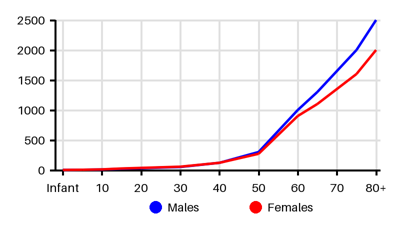
Epidemiology
Incidence per 100.000 [agk]
Symptoms & findings
Symptoms
Crepitations, Dyspnea, Edema, Hypertension, Jugular vein distention, Orthopnea, Polyuria, Third heart sound, Weight gain
Clinical findings
Anemia, Ascites, Decreased Albumin, Decreased Ejection Fraction, Decreased hematocrit, Elevated Central Venous Pressure, Elevated Jugular Venous Pressure, Elevated Pulmonary Artery Pressure, Hemopericardium, Pulmonary edema
Anamneses
None listed.
Approach
Serial weight measurement [sre]
Cumulative fluid balance
Blood test: Electrolytes, creatinine, hematocrit
ECG
Chest x-ray
Lung ultrasound
Echocardiography
Urine microscopy
Central venous or pulmonary artery wedge pressure
Intra-abdominal pressure
Bioelectrical impedance bodycomposition analysis (BIA): a noninvasive method of fluid assessment, can provide estimates of total-body, extracellular, and intracellular water to allow the quantification of fluid overload and setting of dry weight
Treatment
Resuscitation of the critically ill with volume restriction: [sre]
Rescue phase: fluid therapy is provided emergently during acute clinical instability
Stabilization phase: optimize the hemodynamic status and aim for an even or slightly negative fluid balance
De-escalation phase: aim to mobilize accumulated fluid during the initial resuscitation
Fluid removal: depend on renal function, urine output, and severity of fluid overload
Diuretics: 1.0 to 1.5 mg/kg furosemide
Hemodialysis:
Estimate the total quantity of fluid overload (volume of surplus)
The ability to remove fluid from the circulation without inducing hemodynamic instability (cardiac output and tissue perfusion)
Differential diagnoses
Acute liver failure, Asthma, Cancer origo incerta, Cirrhosis, COPD, Deep venous thrombosis, Diabetes insipidus, Fibrosing alveolitis, Heart failure, Hypothyroidism, Inferior vena cava syndrome, Lymphedema, Myocardial infarction, Nephrotic syndrome, Osmotic diuresis, Pneumonia, Portal hypertension, Postobstructive diuresis, Preeclampsia, Pregnancy, Pulmonary embolism, Renal failure
References
[1] O'Connor ME, Prowle JR. Fluid Overload. Crit Care Clin. 2015 Oct;31(4):803-21.
[2] Kreimeier U. Pathophysiology of fluid imbalance. Crit Care. 2000;4 Suppl 2(Suppl 2):S3-7. doi: 10.1186/cc968. Epub 2000 Oct 13.
[3] Chappell, D., Bruegger, D., Potzel, J. et al. Hypervolemia increases release of atrial natriuretic peptide and shedding of the endothelial glycocalyx. Crit Care 18, 538 (2014).
[4] Mitchell KH, Carlbom D, Caldwell E, Leary PJ, Himmelfarb J, Hough CL. Volume Overload: Prevalence, Risk Factors, and Functional Outcome in Survivors of Septic Shock. Ann Am Thorac Soc. 2015 Dec;12(12):1837-44.
[5] Sakaguchi T, Yasumura K, Nishida H, Inoue H, Furukawa T, Shinouchi K, Miura H, Miyazaki K, Hamano G, Koide M, Abe H, Date M, Hirooka K, Koretsune Y, Kusuoka H, Yasumura Y. Quantitative Assessment of Fluid Accumulation Using Bioelectrical Impedance Analysis in Patients With Acute Decompensated Heart Failure. Circ J. 2015;79(12):2616-22.
[6] Arneson TJ, Liu J, Qiu Y, Gilbertson DT, Foley RN, Collins AJ. Hospital treatment for fluid overload in the Medicare hemodialysis population. Clin J Am Soc Nephrol. 2010 Jun;5(6):1054-63.
[7] [First Aid for the Surgery Clerkship]