Diagnosis
Jaundice
Yellowing of the skin and sclera due to an elevation in total bilirubin > 2.5-3 mg/dl or > 43-51 μmol/L.
Also known as: Hyperbilirubinemia, Icterus
Etiology
Cause [r4a]
Prehepatic unconjugated: increased bilirubin production
Hemolysis: blood group incompatibilities, RedBloodCell defects (Sickle-cell anemia, Spherocytosis, Thalassemia, G-6-PD-deficiency, Pyruvate kinase deficiency), Hemolytic–uremic syndrome, intracranial hemorrhage, polycythemia, sepsis
Gilbert syndrome
Crigler-Najjar syndrome
Neonatal jaundice (immature metabolism of bilirubin, clearance is compromised)
Hepatic conjungated/unconjungated: decreased bilirubin metabolism/clearance
Cirrhosis
Viral Hepatitis
Alcoholic liver disease
Cholestatic liver disease: Primary biliary cholangitis, Primary sclerosing cholangitis
Hepatotoxicity / Drug-induced liver injury: sulfa, ceftriaxone, penicillins, oral contraceptives, rifampin, probenecid, steroids, chlorpromazine, herbal medications, arsenic
Gilbert syndrome (prevalence ~5%)
Crigler–Najjar syndrome
Hypothyroidism and cretinism (congenital hypothyroidism)
Leptospirosis
Infiltrative diseases: Amyloidosis, lymphoma, sarcoidosis, tuberculosis
Total parenteral nutrition
Intestinal obstruction and pyloric stenosis
Posthepatic conjungated (elevated ALP): impaired/obstructed hepatobiliary flow
Gallstones: Choledocholithiasis, Mirizzi's syndrome
Cancer: Pancreatic cancer, Cholangiocarcinoma, Hepatocellular carcinoma
Cysts: Choledochal cysts, Pancreatic pseudocysts
Cholestasis of pregnancy
Pancreatitis
Infection: syphilis, toxoplasmosis, HIV, CMV, herpes virus, rubella, parasite (liver flukes)
Congenital: Biliary atresia, Alagille syndrome, alpha-1 anti-trypsin deficiency, galactosemia, fructosemia, Tyrosinemia type 1, cystic fibrosis, progressive familial intrahepatic cholestasis, Aagenaes syndrome, Dubin-Johnson syndrome, bile acid synthesis disorders, Rotor's syndrome
Pathophysiology [r4a]
Prehepatic phase --> Production of bilirubin:
Heme (released by senescent or defective RBCs) --> Biliverdin --> Bilirubin
Hepatic phase:
Unconjugated (non-soluble) bilirubin --> conjugation to glucuronic acid in the hepatocytes resulting in conjugated bilirubin, which is soluble in the bile
Posthepatic phase:
Conjugated bilirubin --> bile canaliculi --> bile ducts --> gallbladder --> ampulla of Vater --> colonic bacteria deconjugate: bilirubin --> urobilinogen
80% excreted into the feces (stercobilin)
10-20% into the enterohepatic circulation
~5% renal excretion (the yellow pigment of urine)
Complication [r4a]
Permanent neurologic injury (kernicterus)
Epidemiology
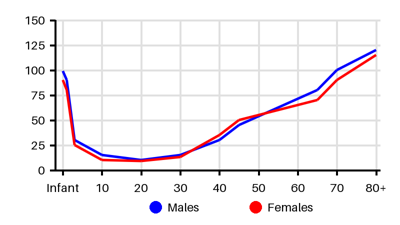
Incidence per 100.000 [kek][hge][wog]
Symptoms & findings
Symptoms
Acholia, Anorexia, Dark urine, Fatigue, Fever, Hepatomegaly, Icterus, Nausea, Pruritus, Spider nevus, Vomiting, Weight loss
Clinical findings
Anemia, Bile duct dilation, Bilirubinuria, Cholestasis, Decreased Haptoglobin, Elevated ALAT, Elevated ALP, Elevated ASAT, Elevated Bilirubin, Elevated GGT, Elevated Lactic Dehydrogenase, Jaundice
Anamneses
None listed.
Localized findings
Approach
Blood test:
Liver function tests: bilirubin (conjugated/unconjugated) ASAT, ALAT, PT-INR, albumine, GGT, ALP
Blood type and Rh determination in mother and infant
Serelogy: hepatitis-serelogy, auto-antibodies, Direct antiglobulin test
Hemolysis: Reticulocyte count, Haptoglobine
Thyroid function tests
Blood gas
Abdominal ultrasound
Abdominal CT
MRCP
Biopsy
Treatment
Treatment of the underlying cause: [r4a]
Symptomatic:
Pruritus: warm baths, oatmeal baths, antihistamine, bile acid sequestrant
Physiologic jaundice: Phototherapy of the newborn
Autoimmune hemolysis: Intravenous immunoglobulin, exchange transfusion
Bile duct blockage:
Bile duct stent (ERCP, PTC)
Kasai
Resection of pancreas, liver or bile ducts
Liver transplantation
Differential diagnoses
Acute pancreatitis, Alcoholic liver disease, Autoimmune hepatitis, Biliary atresia, Cholangiocarcinoma, Choledochal cysts, Choledocholithiasis, Cholelithiasis, Cirrhosis, Crigler-Najjar syndrome, Cytomegalovirus, Drug-induced liver injury, Gilbert syndrome, Hemolysis, Hemolytic anemia, Hypothyroidism, Intestinal atresia, Neonatal hepatitis, Nonalcoholic fatty liver disease, Pancreatic cancer, Primary biliary cirrhosis, Pyloric stenosis, Toxoplasmosis, Viral hepatitis, Wilson's disease
References
[1] Joseph A, Samant H. Jaundice. [Updated 2023 Aug 8]. In: StatPearls [Internet]. Treasure Island (FL): https://www.ncbi.nlm.nih.gov/books/NBK544252/
[2] Nasr P, von Seth E, Mayerhofer R, Ndegwa N, Ludvigsson JF, Hagström H. Incidence, prevalence and mortality of chronic liver diseases in Sweden between 2005 and 2019. Eur J Epidemiol. 2023 Sep;38(9):973-984.
[3] Hansen TWR. Narrative review of the epidemiology of neonatal jaundice. Pediatr Med 2021;4:18.
[4] Taylor A, Stapley S, Hamilton W. Jaundice in primary care: a cohort study of adults aged >45 years using electronic medical records. Fam Pract. 2012 Aug;29(4):416-20.
[5] Björnsson E, Gustafsson J, Borkman J, Kilander A. Fate of patients with obstructive jaundice. J Hosp Med. 2008 Mar;3(2):117-23.
[6] http://emedicine.medscape.com/article/178841 (2014-01-02); [Medscape]
[7] http://emedicine.medscape.com/article/178757 (2014-01-02); [Medscape]
[8] Ansong-Assoku B, Shah SD, Adnan M, et al. Neonatal Jaundice: https://www.ncbi.nlm.nih.gov/books/NBK532930/