Diagnosis
Thrombotic thrombocytopenic purpura
A rare microangiopathic hemolytic anemia classically characterized by fever, hemolytic anemia, thrombocytopenia, purpura, and thrombosis in the kidneys and CNS.
Also known as: Hemolytic uremic syndrome
Etiology
Cause [fuc][47u]
Inherited (congenital): A rare genetic disease transmitted from parents
Acquired: Autoantibodies targeting ADAMTS13
Drugs: platelet aggregation inhibitors, quinine, cocaine, immunosuppression, chemotherapy (mitomycin C, interferon, gemcitabine), antibiotics (trimethoprim, penicillin, rifampin), clopidogrel, estrogen-containing contraceptives
Pregnancy-associated TTP
HIV-associated TTP
Enteritis: Escherichia coli and Shigella dysenteriae
Pathophysiology [47u][1op][zcr][fuc]
Lack of the enzyme ADAMTS13 activity --> no cleaving of the von Willebrand factor
Excessive clotting --> consumption --> thrombocytopenia --> bleeding/petechiae
Erythrocytes destroyed by partially occluded vessels --> hemolytic anemia
Organ affection: usually present with thrombi in the microvasculature of:
The peripheral blood
The central nervous system
The kidneys --> Hemolytic Uremic Syndrome
The lungs (rare)
The heart (rare)
Complications [fuc]
Plasma exchange:
Central venous catheter placement: Pneumothorax, infection, venous thrombosis
Exposure to donor plasma: Transfusion-related acute lung injury
Epidemiology
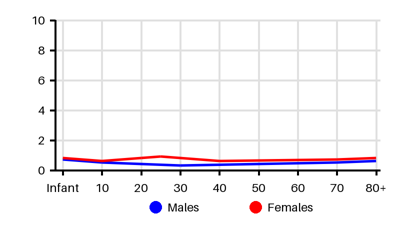
Incidence per 100.000 [vmb][3bz][1gw][47u][1op][ht1][zcr][fuc]
Symptoms & findings
Symptoms
Aphasia, Chills, Coma, Confusion, Dark urine, Diarrhea, Dyspnea, Fatigue, Fever, Hallucinations, Headache, Hemiplegia, Icterus, Malaise, Pallor, Paralysis, Paresis, Paresthesia, Petechia, Seizure, Tachycardia, Vertigo, Weakness
Clinical findings
Anemia, Bilirubinuria, Decreased Haptoglobin, Decreased MCV, Elevated Bilirubin, Elevated Creatinine, Elevated D-dimer, Elevated Fibrinogen, Elevated Lactic Dehydrogenase, Jaundice, Schistocytes, Stroke, Thrombocytopenia
Anamneses
None listed.
Localized findings
Approach
Clinical history
Examination
Blood: Hb, LPK, Trc, LDH, ADAMTS13 activity <10 IU/dL, anti-ADAMTS13 antibody [47u]
Serelogy: HIV, HBV and HCV, autoantibody screen and a pregnancy test
Urine stix
Blood smear
Direct Coombs test
PLASMIC score (1 point per feature) [fuc]
Platelets < 30
Presence of hemolysis
Reticulocytes > 2.5%
Undetectable haptoglobin
Indirect bilirubin greater than 2 mg/dL
MCV < 90 fL
PT-INR < 1.5
Creatinine < 177 µmol/L (2.0 mg/dL)
Absence of cancer
Absence of solid organ or stem cell transplant
Score > 5 --> higher likelyhood of TTP
Treatment
Plasma exchange: 1-1,5 times plasma volumes daily until normal platelet count [47u]
Fresh frozen plasma infusion: 5–75 ml/kg daily (usually 40 mL/kg) [fuc]
Medications that slow anti-ADAMTS13 antibodies formation: [zcr]
IV methylprednisolone (1 g/day for 3 days) or Prednisolone (1 mg/kg/day)
Rituximab 375 mg/m2
Caplacizumab
Mycophenolate mofetil
Cyclosporine
Cyclophosphamide
Cincristine
Bortezomib
Azathioprine (pregnant patients)
Supportive medications once platelet count has improved:
Aspirin
Low‑molecular‑weight heparin
Packed red blood cells
Surgery: Splenectomy (removes a major site of antibody production)
Differential diagnoses
Disseminated intravascular coagulation, Drug side effects, Hemolytic uremic syndrome, Immune thrombocytopenic purpura, Malignant hypertension, Preeclampsia, Scleroderma, Stroke, Systemic lupus erythematosus
References
[1] Stanley M, Killeen RB, Michalski JM. Thrombotic Thrombocytopenic Purpura. [Updated 2023 Apr 7]. In: StatPearls [Internet]. Treasure Island (FL): StatPearls Publishing; 2025 Jan-. Available from: https://www.ncbi.nlm.nih.gov/books/NBK430721/
[2] Thrombotic Thrombocytopenic Purpura. CHI Formulary Indication Review. Council of Health Insurance. November 2023. https://www.chi.gov.sa/Style%20Library/IDF_Branding/Indication/152%20-%20Thrombotic%20Thrombocytopenic%20Purpura%20(TTP)-New%20Indication.pdf
[3] Erkurta MA, Kayaa E, Berbera I, Koroglua M, Kuku I. Thrombocytopenia in Adults: Review Article. Journal of Hematology, Volume 1, Number 2-3, June 2012, pages 44-53.
[4] Nusrat S, Beg K, Khan O, Sinha A, George J. Hereditary Thrombotic Thrombocytopenic Purpura. Genes (Basel). 2023 Oct 18;14(10):1956.
[5] Miller DP, Kaye JA, Shea K, Ziyadeh N, Cali C, Black C, Walker AM. Incidence of thrombotic thrombocytopenic purpura/hemolytic uremic syndrome. Epidemiology. 2004 Mar;15(2):208-15.
[6] George JN, Vesely SK, Terrell DR. The Oklahoma Thrombotic Thrombocytopenic Purpura-Hemolytic Uremic Syndrome (TTP-HUS) Registry: a community perspective of patients with clinically diagnosed TTP-HUS. Semin Hematol. 2004 Jan;41(1):60-7.
[7] George JN. Clinical practice. Thrombotic thrombocytopenic purpura. N Engl J Med 2006;354:1927–35.
[8] Hussein MS, Al Baqir HA, Waznah AS, Alharbi KM et al. 2022. “The Epidemiology and Administration Outcomes of Thrombotic Thrombocytopenic Purpura (TTP): Review Article”. Saudi Medical Horizons Journal 2 (3):124-33.
[9] http://emedicine.medscape.com/article/206598 (2014-01-02); [Medscape]
[10] Cleveland Clinic. Thrombotic Thrombocytopenic Purpura. Published 2022. Accessed September 27, 2023. https://my.clevelandclinic.org/health/diseases/22380-thrombotic-thrombocytopenic-purpura