Diagnosis
Transient ischemic attack
A transient episode of neurologic dysfunction (typically <1 hour) due to focal brain, spinal cord, or retinal ischemia without acute infarction or tissue injury.
Etiology
Cause
Atherosclerosis: carotid and vertebral or intracranial arteries
Embolic sources: valvular disease, atrial fibrillation, aortic arch disease, paradoxical embolism via a patent foramen ovale or atrial-septal defect
Arterial dissection
Arteritis: vasculitis, drugs, irradiation, local trauma, connective tissue diseases
Drugs (cocaine)
Mass lesions (tumors or subdural hematomas)
Hypercoagulable states (Protein C, protein S, and antithrombin III, Activated protein C resistance/factor V Leiden, Fibrinogen,Anticardiolipin antibody, Lupus anticoagulant, Homocysteine, Factor VIII, Von Willebrand factor)
Causes in children: Congenital heart disease, cocaine, Clotting disorders, CNS infection, Neurofibromatosis, Vasculitis, Moyamoya, Fibromuscular dysplasia, Marfan disease, Tuberous sclerosis, Tumor, Sickle cell anemia, Focal arteriopathies
Pathophysiology [3m9]
Source of occlusion:
Cardiac embolism secondary to atrial fibrillation
Large artery atherothrombosis: Atherothrombosis --> occlusion (common)
Small vessel disease: Small vessel arteriolosclerosis with peripheral obliteration
Cryptogenic: Cortical pattern of ischemia without any identifiable source
TIA can be considered a serious warning of an impending ischemic stroke; the risk is highest in the first 48 hours following a transient ischemic attack
Clinical manifestation:
Acute focal neurologic deficit and/or speech disturbance
Risk factor [3m9]
Hypertension
Diabetes
Age
Smoking
Obesity
Alcoholism
Unhealthy diet
Psychosocial stress
Lack of regular physical activity
Complication
Stroke
Epidemiology
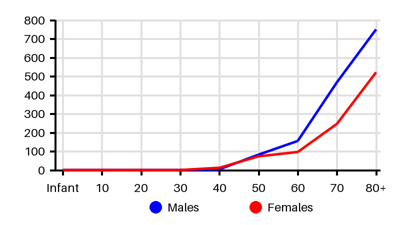
Incidence per 100.000 [csd][ted][dq8][sdd][6s5][ahz][fte]
Symptoms & findings
Symptoms
Abducens nerve palsy, Agnosia, Akinesia, Anopsia, Aphasia, Arrhythmia, Ataxia, Blindness, Diplopia, Dysarthria, Dysphagia, Facial nerve paralysis, Heart murmur, Hyporeflexia, Muscle weakness, Nystagmus, Oculomotor nerve palsy, Paralysis, Paresis, Paresthesia, Scotoma, Vascular murmur, Vertigo, Visual disturbances
Clinical findings
Anamneses
Approach
Blood test: hemoglobin, thrombocytes, glucose, troponins, partial thromboplastin time, PT-INR, toxicology, sedimentation rate, ANA, RF [fte]
Blood gas
ECG
CT caput
MR caput
CT angiography
Doppler ultrasonography
Echocardiography
Lumbar puncture
ABCD2 score for risk stratification: [fte]
Age > 60 = 1p
Blood pressure: Systolic >140 or diastolic >90 = 1p
Clinic: Paresis > speech impairment = 2/1p
Duration: > 60 min > 10-59 min = 2/1p
Diabetes = 1 p
Treatment
Goal of treatment: reduce the risk of stroke with up to 80% [fte][u3f][3m9]
Vascular risk factor reduction:
Anticoagulation for atrial fibrillation
Antiplatelet therapy (aspirin/clopidogrel) if intracranial atherosclerosis
Statins if atherosclerosis
Management of hypertension
Carotid endarterectomy for symptomatic carotid artery stenosis (>50%)
Lifestyle interventions: smoking cessation or weight loss
Differential diagnoses
Brain tumor, Carotid artery dissection, Epilepsy, Hypoglycemia, Hyponatremia, Intracranial hemorrhage, Meningitis, Migraine, Multiple sclerosis, Myocardial infarction, Spinal disc herniation, Stroke, Subarachnoid hemorrhage, Syncope
References
[1] Panuganti KK, Tadi P, Lui F. Transient Ischemic Attack. Updated 2023 Jul 17: https://www.ncbi.nlm.nih.gov/books/NBK459143/
[2] Kleindorfer D, Panagos P, Pancioli A, Khoury J, Kissela B, Woo D, Schneider A, Alwell K, Jauch E, Miller R, Moomaw C, Shukla R, Broderick JP. Incidence and short-term prognosis of transient ischemic attack in a population-based study. Stroke. 2005 Apr;36(4):720-3.
[3] Brown RD Jr, Petty GW, O'Fallon WM, Wiebers DO, Whisnant JP. Incidence of transient ischemic attack in Rochester, Minnesota, 1985-1989. Stroke. 1998 Oct;29(10):2109-13.
[4] Jiang B, Sun H, Ru X, Sun D, Chen Z, Liu H, Li Y, Zhang M, Wang L, Wang L, Wu S, Wang W. Prevalence, Incidence, Prognosis, Early Stroke Risk, and Stroke-Related Prognostic Factors of Definite or Probable Transient Ischemic Attacks in China, 2013. Front Neurol. 2017 Jun 30;8:309.
[5] Komulainen T, Koivisto A, Jäkälä P. Incidence of first-ever transient ischemic attack in Eastern Finland. Acta Neurol Scand. 2022 Nov;146(5):615-622.
[6] Tavosian A, Ström JO, Appelros P. Incidence of Transient Ischemic Attacks in Sweden. Neuroepidemiology. 2016;47(1):20-5.
[7] Barber PA, Krishnamurthi R, Parag V, Anderson NE, Ranta A, Kilfoyle D, Wong E, Green G, Arroll B, Bennett DA, Witt E, Rush E, Minsun Suh F, Theadom A, Rathnasabapathy Y, Te Ao B, Parmar P, Feigin VL; ARCOS IV Study Group. Incidence of Transient Ischemic Attack in Auckland, New Zealand, in 2011 to 2012. Stroke. 2016 Sep;47(9):2183-8.
[8] Coutts SB. Diagnosis and Management of Transient Ischemic Attack. Continuum (Minneap Minn). 2017 Feb;23(1, Cerebrovascular Disease):82-92.
[9] http://emedicine.medscape.com/article/1910519 (2014-02-06); [Medscape]