Diagnosis
Leishmaniasis
A disease caused by the protozoa Leishmania.
Also known as: Kala-azar
Etiology
Cause [hin][1sm]
An intracellular protozoa parasite transmitted by the bite of a female sandfly (Phlebotomus and Lutzomyia) that require blood meals
Pathophysiology [1sm][hin]
Clinical spectrum depends:
Which subtype of phagocytic cells are infected
Host immune status (deficient cell-mediated immunity, malnutrition, AIDS)
Species of parasite (visceral leishmaniasis species are able to grow at core temperatures, while cutaneous leishmaniasis species grow best at lower temperatures)
Cutaneous leishmaniasis:
The parasites infect resident macrophages within the skin
Localized or widespread cutaneous papules and nodules
Visceral leishmaniasis (kala-azar):
The parasites spread hematogenously to mononuclear cells of the liver, spleen, bone marrow, and lymph nodes of the intestine
Potentially lethal systemic disease
Epidemiology
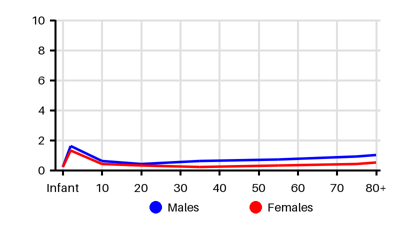
Incidence per 100.000 [cde][m4m][wrg][b6s][v2o][my1]
Symptoms & findings
Symptoms
Arthralgia, Cough, Diarrhea, Epistaxis, Fatigue, Fever, Gingivitis, Headache, Hepatomegaly, Hoarseness, Hyperpigmentation, Lymphadenopathy, Malaise, Myalgia, Nasal congestion, Nausea, Retinal hemorrhage, Rhinorrhea, Saddle nose deformity, Splenomegaly, Weight loss
Clinical findings
Anemia, Hypergammaglobulinemia, Leukopenia, Periodontitis, Thrombocytopenia
Anamneses
None listed.
Localized findings
Approach
Blood test
Biopsy
Culture of infected tissue
Serelogy
PCR
Electrophoresis
Leishmanin Skin Test (Montenegro Test)
Treatment
Prevention: [1sm]
Knowledge of endemic areas
Awareness of nocturnal sandfly activity --> small size pattern bed net
Exposure to animals in areas known to harbor disease
Impregnation with permethrin
Vaccinating dogs and utilizing insecticide dog collars
Pharmacologic therapies include the following: [hin]
Pentavalent antimony (sodium stibogluconate or meglumine antimonate): Used in cutaneous leishmaniasis
Liposomal amphotericin B (AmBisome): Effective against pentavalent antimony ̶ resistant mucocutaneous disease and visceral leishmaniasis
Oral miltefosine (Impavido): for visceral leishmaniasis due to L donovani; cutaneous leishmaniasis due to L braziliensis, L guyanensis, and L panamensis; and mucosal leishmaniasis due to L braziliensis
Intramuscular pentamidine: Effective against visceral leishmaniasis but associated with persistent diabetes mellitus and disease recurrence
Orally administered ketoconazole, itraconazole, fluconazole, allopurinol, and dapsone: None is as effective as the pentavalent antimony compounds, but they may be useful in accelerating cure in patients with cutaneous leishmaniasis that does not progress to mucosal disease and tends to self-resolve
Topical paromomycin: Shown to be effective against cutaneous leishmaniasis caused by L major and L mexicana
Local therapies for cutaneous leishmaniasis:
Cryotherapy
Local heat therapy at 40-42°C
Often resolves spontaneously
Other important issues in the management of leishmaniasis are as follows:
Correction of malnutrition
Treatment of concurrent systemic illness (eg, HIV disease or tuberculosis)
Control of local infection
Differential diagnoses
African trypanosomiasis, Basal cell carcinoma, Blastomycosis, Brucellosis, Chromoblastomycosis, Cutaneous T-cell lymphoma, Diphtheria, Eczema, Endocarditis, Furuncular myiasis, Hemolytic anemia, Histoplasmosis, HIV, Impetigo, Leprosy, Leukemia, Lobomycosis, Lymphoma, Malaria, Mycobacterium avium, Mycobacterium marinum, Nasopharyngeal carcinoma, Orf, Paracoccidioidomycosis, Pinta, Polymorphic reticulosis, Portal hypertension, Psoriasis, Pyoderma gangrenosum, Pyogenic granuloma, Rhinoscleroma, Sarcoidosis, Schistosomiasis, Sporotrichosis, Squamous cell carcinoma, Syphilis, Systemic lupus erythematosus, Tropical pyoderma, Tropical splenomegaly syndrome, Tuberculosis, Tularemia, Typhoid fever, Wegener's granulomatosis, Yaws
References
[1] http://emedicine.medscape.com/article/220298; [Medscape]
[2] Maxfield L, Crane JS. Leishmaniasis. [Updated 2023 Jun 28]. In: StatPearls [Internet]. Treasure Island (FL): StatPearls Publishing; 2025 Jan-. Available from: https://www.ncbi.nlm.nih.gov/books/NBK531456/
[3] Tzani M, Barrasa A, Vakali A, Georgakopoulou T, Mellou K, Pervanidou D. Surveillance data for human leishmaniasis indicate the need for a sustainable action plan for its management and control, Greece, 2004 to 2018. Euro Surveill. 2021 May;26(18):2000159.
[4] Maia-Elkhoury AN, E Yadón Z, Idali Saboyá Díaz M, de Fátima de Araújo Lucena F, Gerardo Castellanos L, J Sanchez-Vazquez M. Exploring Spatial and Temporal Distribution of Cutaneous Leishmaniasis in the Americas, 2001-2011. PLoS Negl Trop Dis. 2016 Nov 8;10(11):e0005086.
[5] Palma D, Mercuriali L, Figuerola J, Montalvo T, Bueno-Marí R, Millet JP, Simón P, Masdeu E, Rius C. Trends in the Epidemiology of Leishmaniasis in the City of Barcelona (1996-2019). Front Vet Sci. 2021 Apr 26;8:653999.
[6] Özbel Y, Töz S, Muñoz C, Ortuño M, Jumakanova Z, Pérez-Cutillas P, Maia C, Conceição C, Baneth G, Pereira A, Van der Stede Y, Gossner CM, Berriatua E. The current epidemiology of leishmaniasis in Turkey, Azerbaijan and Georgia and implications for disease emergence in European countries. Zoonoses Public Health. 2022 Aug;69(5):395-407.
[7] Majidnia M, Ahmadabadi Z, Zolfaghari P, Khosravi A. Time series analysis of cutaneous leishmaniasis incidence in Shahroud based on ARIMA model. BMC Public Health. 2023 Jun 20;23(1):1190.
[8] Majidnia M, Hosseinzadeh A and Khosravi A. Incidence and trend of leishmaniasis and its related factors in Golestan province, northeastern Iran: time series analysis. Epidemiologic Methods, vol. 12, no. 1, 2023, pp. 20220124.