Diagnosis
Respiratory alkalosis
Alveolar hyperventilation causing:
pH > 7.45
Hypocapnia (drop in pCO2)
Decresed HCO3
Etiology
Cause [lvk][psg][ufq][6qw]
Hyperventilation
CNS: Head injury, stroke, anxiety, pain, fear, stress, drugs
Toxicity (Salicylate, Theophylline)
Pulmonary: Hypoxemia --> tachypnea (asthma, COPD, pulmonary embolism, pneumothorax, pneumonia)
Iatrogenic: hyperventilation during mechanical ventilation or ECMO
Anemia
Fever
Hyperthyroidism
Pregnancy
Pathophysiology [psg][ufq][6qw]
The primary pH buffer system in the human body: HCO3/CO2 equilibrium
H+ + HCO3- <--> H2CO3 <--> CO2 + H2O
HCO3 is the alkalotic substance and CO2 is the acidic substance
CO2 is regulated by the pulmonary system through respiration, whereas the HCO3 is regulated through the renal system with bicarbonate reabsorption
Chronic process if metabolic compensation
Increase in alveolar ventilation that is disproportionate to the rate of metabolic carbon dioxide production --> decreased PaCO2
Loss of carbon dioxide --> shift of equilibrium if given time
Metabolic compensation over the course of days:
Consumption of bicarbonate --> alkalosis (pH > 7.45)
Renal decrease of H secretion and increasing HCO3 secretion
Epidemiology
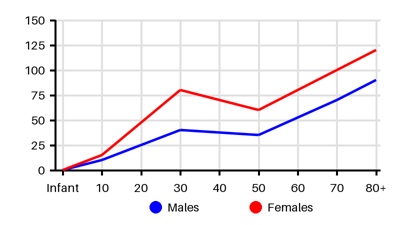
Incidence per 100.000 [lvk]
Symptoms & findings
Symptoms
Confusion, Cough, Decreased consciousness, Diaphoresis, Dizziness, Dyspnea, Fever, Hyperventilation, Muscle cramps, Paresthesia, Seizure, Syncope, Tachycardia, Tachypnea, Wheezing
Clinical findings
Alkalosis, Anemia, Chvostek's sign, Decreased PaCO2, Hypocalcemia, Hypocapnia, Hypokalemia, Hypoxemia, Pleural effusion, Pulmonary edema, Pulmonary infiltrate
Anamneses
None listed.
Approach
Blood test: Complete blood count, liver function, thyroid function, b-HCG, theophylline and salicylate levels
Blood gas: Low HCO3 in chronic respiratory alkalosis
Cultures of blood, sputum, urine, and other sites
Chest x-ray
Chest CT
Ventilation perfusion scanning
MRI Caput
Treatment
Treat the underlying disorder [lvk]
Anxiety: Reassurance, rebreathing into a paper bag, treatment for underlying psychological stress, beta-adrenergic blockers, anxiolytics
Pain: Sedation and pain control
Mechanically ventilated patients: Decrease the tidal volume and/or respiratory rate
Pneumonia: Antibiotics
Pulmonary embolism: Anticoagulation
Differential diagnoses
Acute respiratory distress syndrome, Anxiety, Asthma, Atrial fibrillation, Clostridium tetani, COPD, Drug side effects, Elevated intracranial pressure, Head trauma, Heart failure, Heatstroke, Hyperkalemia, Hyperphosphatemia, Hyperthyroidism, Hyperventilation, Hypocalcemia, Hypocapnia, Hypokalemia, Hypomagnesemia, Hypoparathyroidism, Meningitis, Metabolic acidosis, Metabolic alkalosis, Milk-alkali syndrome, Myocardial infarction, Pleural effusion, Pneumonia, Pneumothorax, Pregnancy, Pulmonary edema, Pulmonary embolism, Pulmonary fibrosis, Sepsis, Thyrotoxicosis
References
[1] http://emedicine.medscape.com/article/301680 (2014-01-02); [Medscape]
[2] Allen GT, Shipman AR, Darragh-Hickey C, Flowers KC, Kaur S, Shipman KE. Investigative algorithms for disorders affecting alkalosis: a narrative review. J Lab Precis Med 2022;7:23.
[3] Brinkman JE, Sharma S. Respiratory Alkalosis [Updated 2023 Jul 24]. In: StatPearls [Internet]. Treasure Island (FL): StatPearls Publishing; 2025 Jan-. Available from: https://www.ncbi.nlm.nih.gov/books/NBK482117/
[4] Sur M, Hashmi MF. Alkalosis. [Updated 2024 Oct 29]. In: StatPearls [Internet]. Treasure Island (FL): StatPearls Publishing; 2025 Jan-. Available from: https://www.ncbi.nlm.nih.gov/books/NBK545269/